Fake Housing Societies in Pakistan: How the New SECP Registration Rules Aim to Protect You in 2026

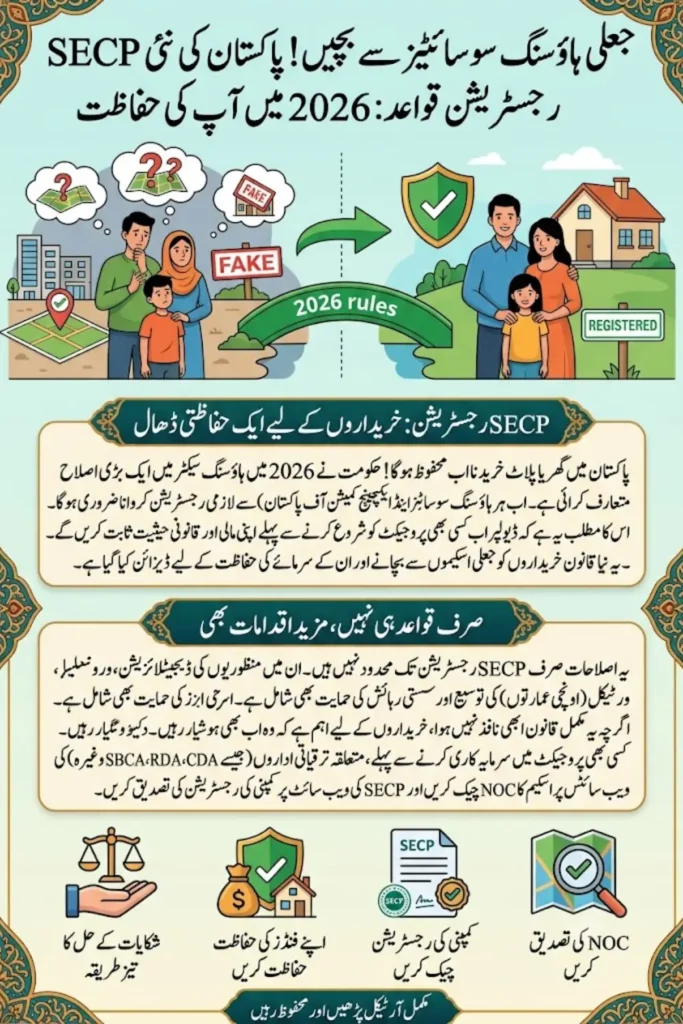
Buying a plot or a home is one of the biggest financial decisions most Pakistani families ever make. Sadly, it’s also one of the easiest ways to lose your life savings. Every year, thousands of people book plots in housing schemes that later turn out to be illegal, unapproved, or simply abandoned halfway through construction. In 2026, the government is finally moving to fix this problem through a major housing sector reform centered on mandatory registration with the Securities and Exchange Commission of Pakistan (SECP). Here’s what it means for you, and how to protect yourself right now — even before the new rules are fully in place.
Why Fake Housing Societies Are Such a Big Problem in Pakistan
Pakistan is short on housing. Estimates suggest the country needs over 10 million additional housing units just to keep up with demand, and that gap grows every year as cities expand. This shortage has created the perfect environment for fraud.
Here’s how it usually plays out:
- A developer buys agricultural land or land with disputed ownership
- Flashy billboards, TV ads, and social media promise “prime location” plots on easy installments
- Buyers rush to book before “prices increase,” often without checking any documents
- The society never gets proper approval, or the developer disappears with the money
- Years later, buyers discover their file is worthless, and courts get flooded with cases that take years to resolve
Because there was no single, strict regulator forcing housing companies to prove they were financially sound and legally compliant before launching a project, this cycle kept repeating.
Also Read: Wazir-e-Azam Apna Ghar Program: Pakistan’s Nationwide 5-Year, Rs 3.2 Trillion Housing Plan
What Is the New SECP Housing Reform?
In a high-level meeting chaired by Prime Minister Shehbaz Sharif, the federal government reviewed a set of proposals to overhaul Pakistan’s real estate sector. The centerpiece of these proposals is mandatory SECP registration for every housing society, real estate developer, and construction company before they are allowed to launch or sell any project.
What “Mandatory SECP Registration” Actually Means
Under the proposed framework:
- Every entity selling plots, houses, or apartments would need to be a properly registered company with the SECP
- Registration would require detailed documentation, financial audits, and compliance checks
- Only companies with a verified track record and financial credibility would be allowed to operate
- Buyers would gain a formal, faster complaint and dispute-resolution route instead of relying only on slow civil courts
Other Parts of the Reform Package
The SECP registration requirement is not the only change under discussion. The broader housing sector reform also includes:
- Digitisation of approvals — a proposed one-window online system so developers don’t have to run between multiple departments for land use, building plan, and utility approvals
- Vertical expansion policy — encouraging high-rise apartment buildings in major cities instead of endless horizontal sprawl, to use land more efficiently
- Master town planning — structured, large-scale urban planning instead of random, unplanned housing schemes
- Support for affordable housing — incentives for developers who reserve a portion of their projects for low-income buyers
Also Read: Apna Ghar Mehfooz Ghar Scheme 2026: Get Rs 5 Lakh Loan for Home Repair
Why This Matters for You as a Buyer
Even in its proposed form, this reform signals a bigger shift: the era of completely unregulated housing marketing in Pakistan is ending. Here’s the practical benefit for ordinary buyers:
| Before This Reform | After Mandatory Registration (Once Enforced) |
|---|---|
| Any company could launch a housing scheme with minimal checks | Companies must prove financial and legal credibility with SECP before launching |
| Buyers had little recourse besides lengthy court cases | A formal regulatory complaint mechanism becomes available |
| Approvals scattered across many departments, easy to fake | Centralised, digital verification makes it harder to forge documents |
| Housing societies could disappear without accountability | Registered companies are traceable and legally accountable |
How to Check If a Housing Society Is Legal Right Now
You don’t have to wait for the new law to protect yourself. Every province and city already has an authority responsible for approving housing schemes. Before you pay a single rupee — even a “token” booking amount — verify the project through the correct official channel:
Punjab
Check the Punjab Housing and Town Planning Authority (PHATA) website for the list of approved housing schemes. This covers Lahore and other Punjab cities under PHATA’s jurisdiction.
Islamabad
Check the Capital Development Authority (CDA) website, which publishes both approved and illegal housing society lists for Islamabad’s CDA and non-CDA sectors.
Rawalpindi
Verify through the Rawalpindi Development Authority (RDA) portal for schemes located in and around Rawalpindi, including Taxila and surrounding areas.
Karachi and Sindh
Use the Sindh Building Control Authority (SBCA) portal to confirm approval status of Karachi-based projects.
Khyber Pakhtunkhwa
Housing schemes in Peshawar and nearby areas fall under the Peshawar Development Authority (PDA).
Quetta and Balochistan
Verify through the Quetta Development Authority (QDA) official listings.
Extra Step: Confirm Company Status with SECP
If the seller is a private limited company (most large housing schemes are), you can independently verify it using SECP’s own company search tool:
- Visit SECP’s official eServices/company search portal
- Search using the company’s main name (skip words like “Private Limited”)
- Confirm it shows a valid registration number (CUIN), an active status, and is not blacklisted
- Cross-check the registered office address against what the developer has advertised
Also Read: Apna Ghar, Mehfooz Ghar: Punjab’s New Home Safety Loan Scheme (2026 Guide)
Red Flags That Should Make You Pause
Watch out for these common warning signs before booking any plot or unit:
- Prices that seem unrealistically low compared to nearby approved societies
- Heavy pressure to “book today” before you’ve verified any documents
- No clear NOC (No Objection Certificate) number that you can independently check
- Marketing materials that show a location different from the officially approved site plan
- Reluctance from the sales team to share original approval letters or the developer’s SECP registration details
- Payment demanded only in cash, with no formal receipt or bank transfer option
If you notice two or more of these red flags, pause and get an independent property lawyer to review the documents before you proceed.
Also Read: PM Apna Ghar Programme 2026: How to Get a Loan from NBFCs (Step-by-Step Guide)
Frequently Asked Questions
Is SECP registration for housing societies already mandatory in Pakistan?
Not yet, as of mid-2026. It is a proposed reform that the federal government is finalising in consultation with the provinces. However, most large housing developers already register as private limited companies with SECP, so you can and should check this regardless of whether it becomes legally mandatory.
What is the difference between SECP registration and development authority approval?
SECP registration confirms the developer is a legally recognised company. Separately, the relevant development authority (like CDA, RDA, PHATA, or SBCA) must approve the actual housing scheme, its layout plan, and its NOC. A buyer should ideally check both.
Can I get my money back if I already invested in an illegal housing society?
It depends on your specific case, documents, and how the fraud occurred. This usually requires legal action through consumer courts or civil courts. Consult a property lawyer as early as possible to understand your options.
Where can I check if a housing society has a valid NOC?
Check the website of the development authority responsible for that city or area — PHATA for Punjab, CDA for Islamabad, RDA for Rawalpindi, SBCA for Karachi, PDA for Peshawar, and QDA for Quetta.
Will this reform stop all housing fraud in Pakistan?
No single reform can eliminate fraud completely, but mandatory registration, financial audits, and a centralised digital approval system are expected to make it significantly harder for fake developers to operate and easier for buyers to verify projects before investing.
Also Read: Apni Chhat Apna Ghar Scheme 2026 Rs. 10 Lakh Interest-Free Loan Guide