PM Apna Ghar Programme 2026: How to Get a Loan from NBFCs (Step-by-Step Guide)

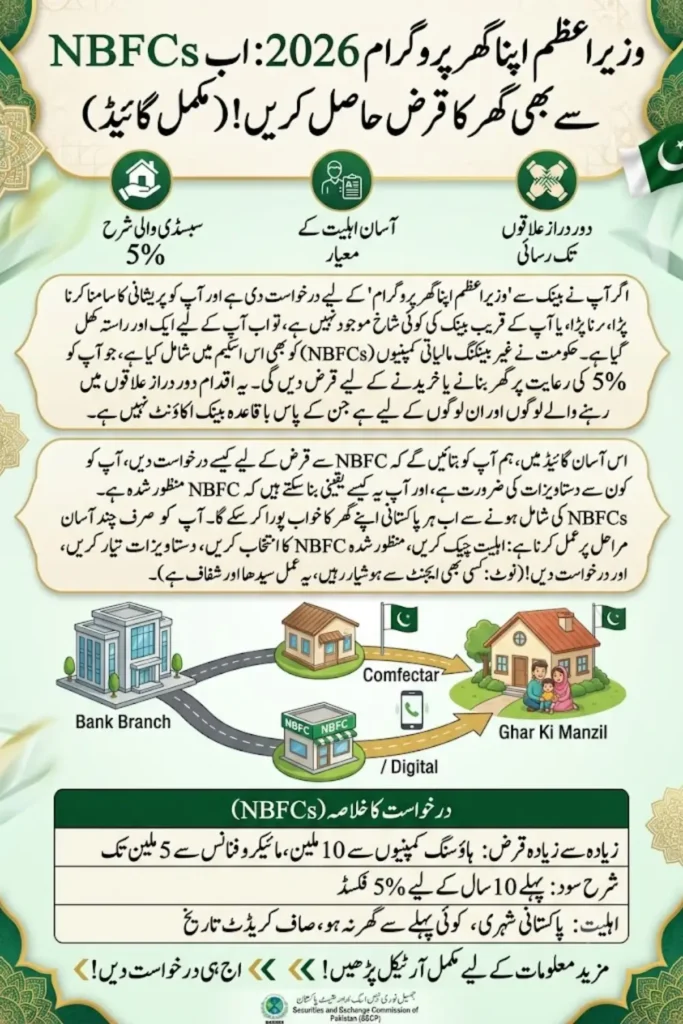
If you tried applying for the PM Apna Ghar Programme through a bank and found the process difficult, or there’s no major bank branch near you, there’s now another route: NBFCs (Non-Banking Finance Companies). In July 2026, the federal government confirmed that NBFCs can now also offer home loans under this scheme — at the same subsidised 5% rate.
This guide walks you through exactly how to apply for a loan through an NBFC, what documents you’ll need, and how NBFCs compare to banks, so you can choose the option that works best for you.
Why Were NBFCs Added?
On the recommendation of the Securities and Exchange Commission of Pakistan (SECP), the federal government has brought eligible NBFCs into the scheme as Participating Financial Institutions (PFIs). The reasoning is simple: many people, especially in remote and underserved areas, don’t have a relationship with a traditional bank. NBFCs generally have stronger digital and local outreach, so adding them widens the scheme’s reach.
| NBFC Type | Maximum Loan |
|---|---|
| Non-bank housing finance companies | Up to Rs 10 million |
| Investment finance companies | Up to Rs 10 million |
| Microfinance companies | Up to Rs 5 million |
The rate stays the same across the board — a fixed 5% markup for the first 10 years, shifting to a market-linked rate afterwards.
Also Read: Wazir-e-Azam Apna Ghar Program: Pakistan’s Nationwide 5-Year, Rs 3.2 Trillion Housing Plan
Step-by-Step: How to Get a Loan from an NBFC
Step 1:
Before applying, check that you meet these basic conditions:
- You’re a Pakistani citizen with a valid CNIC
- You’re roughly between 25 and 60 years old (up to 65 if self-employed)
- You’re a first-time home buyer — meaning you don’t already own residential property anywhere in Pakistan
- You have a stable, verifiable source of income
- You have a clean credit history, with no previous loan defaults
Step 2:
Each type of NBFC serves a slightly different purpose:
- Housing finance companies and investment finance companies: A good fit if you need a larger loan (up to Rs 10 million) and can provide more formal documentation.
- Microfinance companies: A better fit if your income is modest, you need a smaller loan (up to Rs 5 million), or you don’t have much traditional banking history.
Step 3:
This step matters a lot. Since this is a brand-new framework, not every NBFC will be onboarded right away. Before applying:
- Check the SECP’s official announcements to confirm the NBFC is listed as an approved Participating Financial Institution
- If you’re unsure, ask the NBFC directly whether they are officially registered under the PM Apna Ghar Programme
Keep this in mind: Never trust an “agent” or unofficial website that promises faster approval in exchange for a processing fee. This scheme does not require any middleman.
Step 4:
Have the following ready before you apply through an NBFC:
- CNIC copy
- Proof of income (salary slips, business records, or bank statements)
- Employment or business details
- Details of the property you want to purchase or construct (address, size, value)
- Ownership documents, if you already own the plot
Step 5:
- Visit the NBFC’s branch, or use their digital/online application if one is available
- Fill out the application form and attach your documents
- The NBFC will assess your income and repayment capacity
Step 6:
- Initial processing usually takes about 15 days
- Final approval is typically given within about one month, if your documents are complete
- Once approved, funds are released according to the construction or purchase stage
Also Read: Apna Ghar Mehfooz Ghar Scheme 2026: Get Rs 5 Lakh Loan for Home Repair
Bank vs NBFC: What’s the Difference?
| Factor | Bank | NBFC |
|---|---|---|
| Maximum loan | Rs 10 million | Rs 10 million (housing/investment) or Rs 5 million (microfinance) |
| Markup rate | 5% fixed (first 10 years) | Same 5% |
| Best for | Salaried individuals with formal banking history | People who are unbanked or live in remote areas |
| Branch presence | Traditional bank branches | Wider digital and local outreach |
| Documentation | Standard bank paperwork | Often more flexible |
| Partnership option | Not applicable | Can partner with banks and other NBFCs |
If you already have a good relationship with a bank, that route may be smoother. But if you don’t have a bank account, or your income comes from an informal source such as a small business, the NBFC route may be more practical for you.
Things to Keep in Mind When Applying Through an NBFC
- Confirm the NBFC’s SECP-approved status. This is the single most important step before applying.
- Compare processing timelines. Speed can vary from one NBFC to another.
- Remember the 10-year subsidy window. The 5% rate only applies for the first 10 years; after that, the market rate takes over.
- Plan your budget realistically. Don’t simply borrow the maximum you’re eligible for — choose a loan slab that matches your actual repayment capacity.
- Never pay an upfront “processing fee” requested outside official channels.
Who Benefits Most from the NBFC Route?
- Small business owners who don’t have formal salary slips
- People living in remote or rural areas with limited bank branches nearby
- Applicants who were previously rejected by traditional banks because their documentation didn’t fit the standard format
- People who prefer a digital-first process, since many NBFCs offer more modern online or app-based systems
Also Read: Apna Ghar, Mehfooz Ghar: Punjab’s New Home Safety Loan Scheme (2026 Guide)
Application Timeline: What to Expect
| Stage | Approximate Time |
|---|---|
| Initial document submission | Day 1 |
| Initial processing | Within 15 days |
| Final approval | Within about 1 month (if documents are complete) |
| Loan disbursement | After approval, based on construction/purchase stage |
Frequently Asked Questions (FAQs)
1. Can every NBFC offer loans under the PM Apna Ghar Programme?
No, only NBFCs officially approved under SECP’s new framework can do so. Always confirm this before applying.
2. Is getting a loan from an NBFC harder or easier than from a bank?
It depends on your situation. NBFCs often have more flexible documentation requirements, which can help applicants who are unbanked or have informal income.
3. Is the markup rate different between NBFCs and banks?
No, both offer the same subsidised 5% fixed rate for the first 10 years.
4. What’s the maximum loan I can get from a microfinance company?
Microfinance companies can lend up to Rs 5 million, while housing and investment finance companies can lend up to Rs 10 million.
5. Can an NBFC offer a loan in partnership with a bank?
Yes, under the new framework, NBFCs can partner with banks and other financial institutions to provide housing finance.
6. How long does approval usually take?
Initial processing takes about 15 days, and final approval is typically given within one month if your documents are complete.
7. Will I need to pay a processing fee?
There’s no hidden fee in the official process. If anyone asks for money to “speed up” your application, treat it as a scam.
8. Can I apply if I already own a house?
No, this scheme is only for first-time home buyers who don’t already own residential property in Pakistan.
Also Read: Apni Chhat Apna Ghar & Apni Zameen Apna Ghar: Punjab Progress Update 2026
Final Thoughts
The inclusion of NBFCs in the PM Apna Ghar Programme is a genuine opportunity for people who were previously left out of the traditional banking system. But since this is a very new framework, it’s worth being patient — not every NBFC will be onboarded immediately, and the exact process may vary slightly between institutions. The most important step is this: confirm the NBFC’s officially approved status before applying, then prepare your documents and start the process.
Also Read: Mera Ghar Mera Ashiana vs PM Apna Ghar vs Apni Chhat Apna Ghar Which One Is Right for You?