Apni Chhat Apna Ghar Scheme 2026 Rs. 10 Lakh Interest-Free Loan Guide

Owning a home is a dream for millions of families in Punjab. Rent keeps going up every year, construction material prices have almost doubled since 2022, and bank loans come with markup rates that a daily-wage earner simply cannot afford. The Punjab government’s Apni Chhat Apna Ghar (ACAG) scheme was designed exactly for this problem — and in July 2026, it just got bigger.
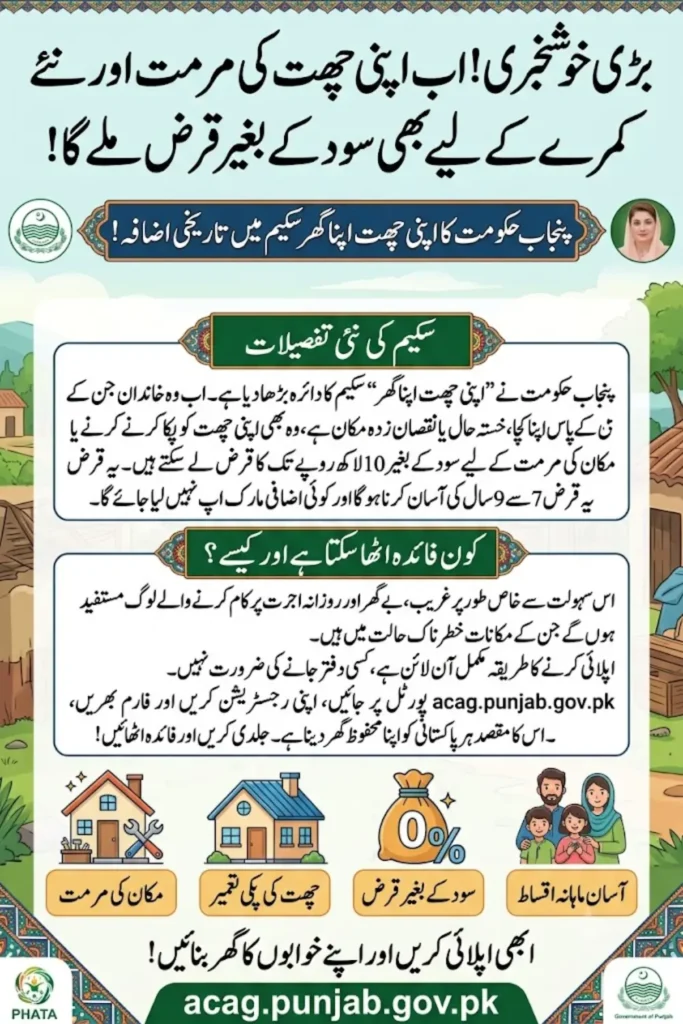
The government has now expanded the programme so that eligible families can get interest-free loans of up to Rs. 10 lakh (Rs. 1 million) — not just for building a new house, but also for repairing an old one or replacing a damaged roof. This is on top of the original ACAG facility, which already offers up to Rs. 15 lakh interest-free for full house construction.
In this guide, we’ll break down everything in simple words: what changed, who qualifies, how much you can get, and exactly how to apply online.
What Is the Apni Chhat Apna Ghar Scheme?
Apni Chhat Apna Ghar is a flagship housing programme launched by Chief Minister Punjab Maryam Nawaz Sharif in August 2024. It is run by the Punjab Housing & Town Planning Agency (PHATA), under the Housing, Urban Development & Public Health Engineering Department (HUD&PHED).
The core idea is simple: many families in Punjab already own a small piece of land but don’t have the money to build a proper house on it. Instead of forcing them to take a bank loan with heavy markup, the government gives them a 0% interest loan, repayable in small monthly instalments.
So far, the scheme has approved loans for more than 170,000 families across Punjab, and the government now plans to extend this facility to another 100,000 households in the coming fiscal year.
Also Read: Apni Chhat Apna Ghar & Apni Zameen Apna Ghar: Punjab Progress Update 2026
What’s New in the July 2026 Update?
This is the part most people are searching for right now. Housing Minister Bilal Yasin, in a meeting attended by the Secretary Housing, the President of Bank of Punjab, and the DG of PHATA, announced a major expansion:
- Interest-free loans of Rs. 500,000 to Rs. 1 million (up to Rs. 10 lakh) are now available not just for new construction, but also for:
- Repairing an existing damaged or unsafe house
- Rebuilding a weak or collapsing roof
- This part of the scheme specifically targets homeless families, low-income households, and people living in temporary, damaged, or unsafe housing.
- Applications for this facility will be processed through a dedicated online e-portal, so people won’t need to visit any government office.
In short, ACAG is no longer just a “build a new house” scheme — it now also acts as a safety net for families whose homes are structurally weak, which has become an urgent issue after several roof-collapse incidents were reported in different parts of Punjab.
Also Read: Apna Ghar, Mehfooz Ghar: Punjab’s New Home Safety Loan Scheme (2026 Guide)
ACAG at a Glance
| Feature | Details |
|---|---|
| Scheme name | Apni Chhat Apna Ghar (ACAG) |
| Launched by | CM Punjab Maryam Nawaz Sharif (August 2024) |
| Executing agency | PHATA (Punjab Housing & Town Planning Agency) |
| Interest rate | 0% (completely interest-free) |
| Loan for new construction | Up to Rs. 1.5 million (15 lakh) |
| Loan for repair / roof rebuilding (new, 2026) | Rs. 500,000 to Rs. 1 million (10 lakh) |
| Subsidy | Up to 60% of construction cost for eligible categories |
| Repayment period | 7 to 9 years |
| Approx. monthly instalment | Around Rs. 14,000 (on maximum loan) |
| Grace period | First few months, no instalment required |
| Official portal | acag.punjab.gov.pk |
| Coverage | All 36 districts of Punjab |
Who Can Apply? (Eligibility Criteria)
To be eligible for the Apni Chhat Apna Ghar loan, you generally need to meet these conditions:
- You must be a permanent resident of Punjab, verified through your CNIC.
- You must be the head of the family as per NADRA records.
- You must own a small plot of land:
- Up to 5 marla in urban areas
- Up to 10 marla in rural areas
- You must not already own a fully constructed house anywhere in Punjab.
- Your monthly household income should generally be below Rs. 60,000.
- You must be registered with the National Socio-Economic Registry (NSER), with a PMT score of 60 or below. (PMT stands for Proxy Means Test — it measures your household’s financial condition based on income and assets.)
- For the repair/roof loan specifically, your home should be in a damaged, weak, or unsafe condition.
The government has also set aside special quotas for:
- Women-headed households
- Minorities
- Persons with disabilities
- Daily-wage earners
- Small shopkeepers
Also Read: PM Apna Ghar Programme 2026: How to Get a Loan from NBFCs (Step-by-Step Guide)
Documents You Will Need
Before you start your online application, keep these documents ready:
- CNIC – front and back, clear scanned copy
- Proof of land ownership – Fard, registry, or allotment letter (must be verifiable through the Punjab Land Record Authority, PLRA)
- Possession document – proof that you physically hold the plot
- Income proof – salary slip or last 6 months’ bank statement
- Passport-size photographs – usually 2 to 4, with a plain blue or white background
- Affidavit – a signed statement confirming you don’t own any other property (a template is available on the portal)
How to Apply Online for ACAG 2026
Applying is fully digital now, which means you don’t need to stand in long queues at any government office. Here’s the step-by-step process:
Step 1:
Go to acag.punjab.gov.pk. This is the only official website for registration — avoid any other site claiming to offer ACAG registration.
Step 2:
Register using your CNIC number and a mobile number registered in your own name. You’ll receive an OTP for verification.
Step 3:
Enter your personal details, land ownership information, income details, and choose the correct category — new construction, or the repair/roof-rebuilding facility, depending on your need.
Step 4:
Upload clear scans of all the documents listed above.
Step 5:
Once submitted, you can log in anytime with your CNIC and password to check your application status. You’ll also get SMS or email alerts whenever your status changes.
Step 6:
After document verification and field visits, eligible applicants go through a computerised balloting process. If your status shows “Approved,” your loan agreement and disbursement process begins.
How the Loan Is Disbursed
The loan isn’t given as one lump sum — it comes in phases, tied to your construction progress:
- First instalment – released once your loan agreement is signed
- Second instalment – released after some construction work is completed
- Third instalment – released on further progress
The Chief Minister has specifically directed that the second instalment be released promptly, usually within a few days of the first, so families don’t face construction delays.
ACAG vs. the New Repair/Roof Loan – What’s the Difference?
People often get confused between the original construction loan and the new repair facility. Here’s a simple comparison:
| Point | Construction Loan (Original) | Repair/Roof Loan (New, 2026) |
|---|---|---|
| Purpose | Build a new house from scratch | Repair a damaged house or rebuild a weak roof |
| Maximum amount | Up to Rs. 15 lakh | Up to Rs. 10 lakh |
| Target group | Plot owners who can’t afford construction | Families living in unsafe or damaged homes |
| Land requirement | Must own a plot (5 marla urban / 10 marla rural) | Must already have an existing but weak structure |
| Application mode | acag.punjab.gov.pk | Dedicated e-portal (linked from the same platform) |
Why This Update Matters
Several incidents of roof collapses in different parts of Punjab, including in areas like Kahna, have pushed the government to treat home safety as an urgent issue — not just a housing shortage issue. By allowing interest-free loans specifically for repair and roof reconstruction, the scheme now protects families from immediate physical danger, not only from the long-term burden of not owning a home.
For a family paying rent every month, this update also makes financial sense: paying roughly Rs. 14,000 a month toward your own home builds an asset, while the same amount spent on rent builds nothing.
Also Read: Apni Chhat Apna Ghar Scheme 2026: Latest Progress & How to Check Your Application Status
Common Mistakes to Avoid
- Don’t pay anyone for an “Apni Chhat Apna Ghar list PDF.” Several fraudulent websites and agents charge people for fake lists. Your application status is only valid if checked on acag.punjab.gov.pk.
- Don’t use someone else’s mobile number for registration — this can cause OTP and verification issues.
- Don’t submit unclear or incomplete documents — this is one of the most common reasons applications get delayed or rejected.
- Don’t ignore SMS updates from the official portal, as they often carry important deadlines.
If you face delays beyond 45 days, you can call the PHATA helpline: 0800-09100 with your tracking ID ready.
Frequently Asked Questions (FAQs)
Q1: Is the Apni Chhat Apna Ghar loan really interest-free?
Yes. It carries 0% markup. The Punjab government covers the financial cost and, for eligible categories, also provides up to 60% subsidy on construction cost.
Q2: What is the maximum loan amount under the new update?
For repair and roof-rebuilding, the loan ranges from Rs. 500,000 to Rs. 1 million (up to Rs. 10 lakh). For new house construction under the original scheme, the ceiling is Rs. 1.5 million (15 lakh).
Q3: Can I apply if I already have a house but it’s badly damaged?
Yes. The July 2026 expansion is specifically meant for families whose homes are damaged, weak, or unsafe, including roof repair cases.
Q4: What is the repayment period?
Loans are generally repayable over 7 to 9 years, with a grace period of a few months before the first instalment is due.
Q5: Is this scheme available outside Punjab?
No. Apni Chhat Apna Ghar is a Punjab-specific programme. Residents of other provinces are not eligible, though the federal government runs a separate scheme called the Wazir-e-Azam Apna Ghar Programme, which is not interest-free.
Q6: How do I check my application status?
Log in to acag.punjab.gov.pk with your CNIC and password. You’ll also get SMS or email alerts automatically when your status changes.
Q7: What if I don’t own any land at all?
If you’re landless, ACAG isn’t for you directly. Instead, look into the companion programme, Apni Zameen Apna Ghar (AZAG), which provides free plots to eligible landless families, who can then apply for ACAG once they have land.
Also Read: Apna Ghar Mehfooz Ghar Scheme 2026: Get Rs 5 Lakh Loan for Home Repair
Final Word
The Apni Chhat Apna Ghar Scheme 2026 has evolved from a simple construction-loan programme into a broader housing safety net for Punjab’s low-income families. Whether you need help building a new home or repairing a dangerous, crumbling one, the interest-free loan facility — now going up to Rs. 10 lakh for repairs — is one of the most practical relief options currently available.
If you think you qualify, don’t wait. Gather your CNIC, land documents, and income proof, and apply directly through acag.punjab.gov.pk. Avoid third parties, and only trust official government channels for updates on your application.
Also Read: Wazir-e-Azam Apna Ghar Program: Pakistan’s Nationwide 5-Year, Rs 3.2 Trillion Housing Plan