Mera Ghar Mera Ashiana Scheme: Complete Timeline of Every Update (2025–2026)

If you’ve been following news about Mera Ghar Mera Ashiana, you’ve probably noticed the scheme keeps changing — loan limits go up, markup rates get revised, and new banks keep joining. It’s easy to lose track of what’s actually current. This article puts every major update in one place, in chronological order, so you always know exactly where things stand. We’ll keep this page updated as new changes are announced, so bookmark it if you’re planning to apply.
What Is Mera Ghar Mera Ashiana?
Mera Ghar Mera Ashiana is a Markup Subsidy and Risk Sharing Scheme for Affordable Housing Finance, introduced by the Government of Pakistan and implemented through the State Bank of Pakistan (SBP) and participating commercial and Islamic banks. In simple terms, the government covers part of the interest cost so that ordinary families can get home financing at a much lower rate than the open market offers.
Also Read: Mera Ghar Mera Ashiana Scheme 2026: Islamic vs Conventional Home Financing Which One Is Better?
The Complete Timeline
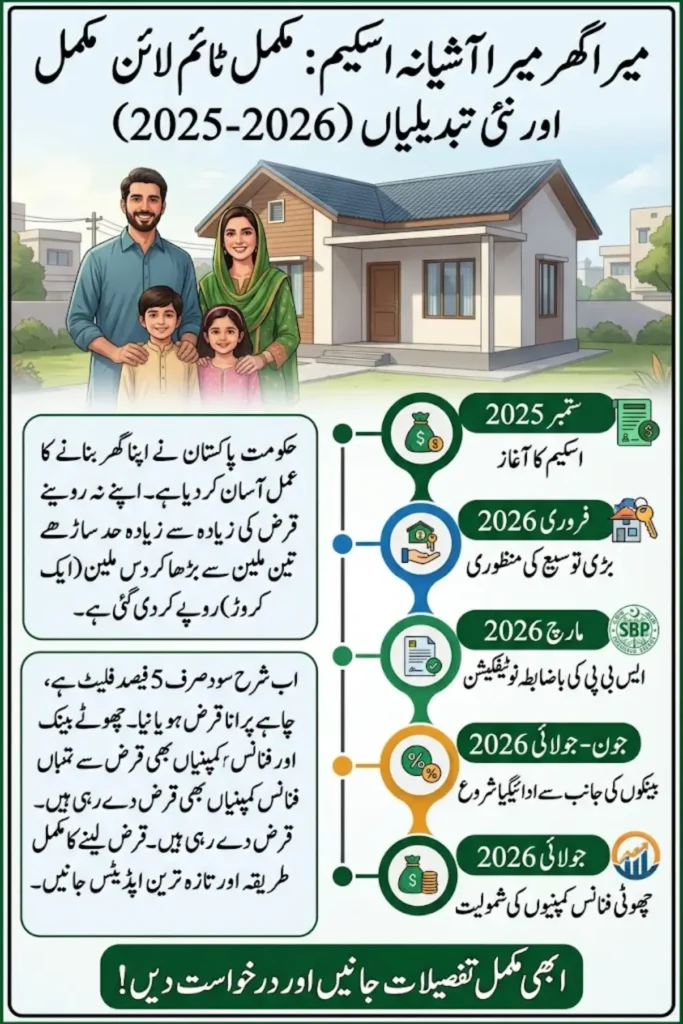
September 2025 — The Scheme Is Launched
The federal government introduced Mera Ghar Mera Ashiana as a new Markup Subsidy and Risk Sharing Scheme aimed at boosting affordable housing finance. At launch, the scheme had a lower loan ceiling and smaller eligible property sizes compared to what’s available today, with a tiered pricing structure — 5% markup for one tier and 8% for another.
February 2026 — ECC Approves a Major Expansion
The Economic Coordination Committee (ECC) of the Cabinet, chaired by the Federal Minister for Finance and Revenue, reviewed the scheme’s performance after its first few months. The committee noted that the scheme had already generated strong public response, with over 10,594 loan applications received and disbursements underway.
Based on this response, the ECC approved a significant revision:
- Loan limit increased to a maximum of Rs. 10 million
- Eligible housing size expanded
- Uniform 5% end-user pricing introduced, replacing the earlier two-tier structure (5%/8%)
- Four-year scaling target set for housing finance under the scheme
- Adjustment of already-disbursed loans to the new, lower 5% rate
This was the single biggest policy shift in the scheme’s history, effectively doubling the amount families could borrow while also making the pricing simpler and cheaper.
March 2026 — SBP Formally Notifies the New Features
Following the ECC’s approval, the State Bank of Pakistan issued a formal notification implementing the revised features. This is where the exact numbers were confirmed:
| Feature | Old Limit | New Limit (March 2026) |
|---|---|---|
| Maximum loan amount | Rs. 3.5 million | Rs. 10 million |
| Eligible house size | 5 Marla | 10 Marla (approx. 2,720 sq. ft.) |
| Eligible flat size | 1,360 sq. ft. | 1,500 sq. ft. |
| Markup rate | 5% (Tier 1) / 8% (Tier 2) | Flat 5% for all customers |
| Loan tenure | Up to 20 years | Up to 20 years (unchanged) |
SBP directed all Participating Financial Institutions (PFIs) to properly communicate these revised features to customers through their branch networks and other channels — meaning banks were required to actively inform applicants of the better terms, not just apply them quietly.
June–July 2026 — Banks Ramp Up Disbursements
With the improved terms in place, participating banks began reporting stronger uptake. Meezan Bank, Pakistan’s largest Islamic bank, announced it had crossed Rs. 2 billion in cumulative disbursements under the broader “Ghar Ho Tu Apna” umbrella that includes Mera Ghar Mera Ashiana, alongside its highest-ever monthly housing disbursement figure of Rs. 1.3 billion. This signaled that the scheme had moved well past the announcement stage and was delivering real financing to real families.
July 2026 — Non-Bank Financial Institutions Join the Scheme
In a move to widen access beyond traditional banks, the Securities and Exchange Commission of Pakistan (SECP) approved the inclusion of Non-Banking Finance Companies (NBFCs) as Participating Financial Institutions under the broader PM Apna Ghar framework. This means:
- Housing finance and investment finance companies can now lend up to Rs. 10 million
- Microfinance companies can now lend up to Rs. 5 million
This update matters most for applicants who don’t have an existing bank relationship or live in areas where bank branch access is limited, since NBFCs and microfinance companies often reach communities that traditional banks don’t prioritize.
Also Read: Mera Ghar Mera Ashiana Loan 2026: Fixed vs Floating Markup – Which Option Saves You More?
Where Things Stand Today (as of Mid-2026)
Here’s the current, confirmed snapshot of the scheme:
- Maximum loan: Rs. 10 million
- Markup rate: Flat 5% (subsidized period)
- Tenure: Up to 20 years
- House size limit: 10 Marla (approx. 2,720 sq. ft.)
- Flat size limit: 1,500 sq. ft.
- Who can lend: Commercial banks, Islamic banks, and now NBFCs/microfinance companies
- Usage: Buying a house/flat, buying a plot, or constructing on land you already own
Also Read: Mera Ghar Mera Ashiana vs PM Apna Ghar vs Apni Chhat Apna Ghar Which One Is Right for You?
What This Timeline Tells Us About Where the Scheme Is Headed
Looking at the pattern of updates over the past year, a few trends are worth watching:
- The government is responsive to demand. Each major revision followed evidence of strong applicant interest, suggesting future expansions are likely if demand continues to grow.
- Access is widening, not narrowing. From a bank-only scheme to one that now includes NBFCs and microfinance companies, the direction has consistently been toward including more types of applicants and institutions.
- Pricing is simplifying. The shift from a two-tier (5%/8%) structure to a single flat 5% rate suggests the government is prioritizing simplicity and predictability for borrowers.
Also Read: Meezan Bank Mera Ghar Mera Ashiana Loan 2026: Rs. 2 Billion Disbursed Here’s What It Means for You
Frequently Asked Questions
What was the original loan limit when the scheme launched?
At launch in September 2025, the scheme had a lower loan ceiling of Rs. 3.5 million, later increased to Rs. 10 million following the February 2026 ECC approval.
Is the 8% markup tier still available?
No. As of March 2026, the government standardized pricing to a flat 5% for all customers, replacing the earlier 5%/8% tiered structure entirely.
Do older loans get the new 5% rate too, or only new applicants?
According to the ECC’s approved revision, already-disbursed loans were adjusted to the new 5% rate as well, not just new applications going forward.
Can I apply through an NBFC instead of a bank?
Yes, as of July 2026, NBFCs and microfinance companies are approved as Participating Financial Institutions, offering loans up to Rs. 10 million and Rs. 5 million respectively.
How do I know if a bank is officially participating in the scheme?
Check directly with the bank or refer to SBP’s list of Participating Financial Institutions, since this list is updated periodically as new institutions are approved.
Will the loan limit increase further in the future?
There’s no official confirmation of further increases at this time, but given the pattern of expansions over the past year, applicants should keep an eye on future ECC and SBP announcements.
Also Read: Can Overseas Pakistanis Apply for Mera Ghar Mera Ashiana Scheme 2026? Complete Guide for NRPs