Mera Ghar Mera Ashiana Loan 2026: Fixed vs Floating Markup – Which Option Saves You More?

Owning a home is a dream for almost every Pakistani family. The Mera Ghar Mera Ashiana (MGMA) scheme has brought that dream closer for thousands of low and middle-income households. But once you sit down with a bank officer to apply, one question always comes up and confuses most applicants: should you choose a fixed markup or a floating markup?
This is not just a technical detail. This one decision will affect your monthly instalment, your household budget, and your peace of mind for the next 10 to 20 years. In this guide, we will explain in simple words which option makes more sense for you when applying for the Mera Ghar Mera Ashiana loan in 2026.
What Is the Mera Ghar Mera Ashiana Scheme 2026?
Mera Ghar Mera Ashiana, officially known as the “Markup Subsidy and Risk Sharing Scheme for Affordable Housing Finance,” is a joint initiative of the Government of Pakistan and the State Bank of Pakistan (SBP). Its goal is to give affordable home financing to low and middle-income families, especially first-time buyers who do not already own a house.
The biggest benefit of this scheme is that the government pays a subsidy on the markup rate for the first 10 years. Because of this, even though the bank’s normal lending rate may be above 20%, the customer only pays 5% or 8%, depending on the loan tier.
Also Read: Who Can Apply for Mera Ghar Scheme 2026? Complete Eligibility Guide
Quick Overview of the Scheme
| Feature | Details |
|---|---|
| Property size | House up to 5 Marla, or a flat up to 1,360–1,500 sq ft (varies by bank) |
| Loan amount | From around PKR 2 million up to PKR 1 Crore, depending on the tier and bank |
| Subsidised markup | 5% (Tier-1) or 8% (Tier-2) for the first 10 years |
| Down payment | Roughly 10% (loan covers up to 90% of the property value) |
| Maximum tenure | Up to 20 years |
| Eligibility | Pakistani CNIC holder, first-time home buyer, no property already owned |
| Participating banks | HBL, UBL, MCB, Bank Alfalah, Meezan Bank, NBP, Standard Chartered, HBFCL, and others |
These figures and limits are updated from time to time, so always confirm the latest circular with your bank before applying.
Also Read: Mera Ghar Mera Ashiana Loan Approval Process 2026: How Long Does Bank Verification Take?
What Is a Fixed Markup?
A fixed markup means simple: whatever rate you get when you take the loan stays the same throughout the subsidy period (the first 10 years). Whether market interest rates go up or down, your monthly instalment does not change.
In the Mera Ghar Mera Ashiana scheme, this fixed rate is only possible because of the government subsidy. The bank charges its actual cost of funds, and the government covers the difference.
Benefits of a Fixed Markup
- Predictability: You know exactly how much you need to pay every month, which makes budgeting much easier.
- Protection from rate hikes: If the State Bank raises the policy rate, as it has done in 2026, your instalment stays safe.
- Peace of mind: With a fixed instalment, it’s easier to plan around other expenses like children’s education and daily household costs.
- Ideal for first-time buyers: Anyone taking a home loan for the first time usually benefits more from stability than from taking a risk.
Drawbacks of a Fixed Markup
- If market rates fall in the future, you will not benefit directly from that drop (though the subsidised rate is already much lower than market rates anyway).
- After 10 years, once the subsidy period ends, the rate usually switches to a floating rate based on 1-year KIBOR plus a margin (for example, KIBOR + 3%). This means the “fixed” comfort does not last for the entire loan tenure.
What Is a Floating Markup?
A floating (or variable) markup is a rate linked to a benchmark, usually KIBOR (Karachi Interbank Offered Rate). When KIBOR goes up, your instalment goes up. When it comes down, your instalment goes down too.
Most regular bank home loans, outside of subsidy schemes like MGMA, work on this model — for example, “1-year KIBOR + 3%” or “6-month KIBOR + 2.5%”.
Benefits of a Floating Markup
- If interest rates in the economy start falling, you benefit immediately with a lower instalment.
- Over a long period, if the country’s monetary policy stabilises and rates drop, your total repayment could turn out lower than a fixed rate.
Drawbacks of a Floating Markup
- Unpredictability: Every time KIBOR is revised (usually monthly or quarterly), your instalment can increase or decrease.
- Pakistan’s interest rate history shows that rates can be quite volatile due to inflation and currency pressures.
- In 2026 alone, the State Bank changed its policy rate to 11.5% while inflation moved into double digits. In this kind of environment, a floating-rate borrower’s instalment can rise suddenly and by a large amount.
Also Read: Mera Ghar Mera Ashiana Scheme 2026: Islamic vs Conventional Home Financing Which One Is Better?
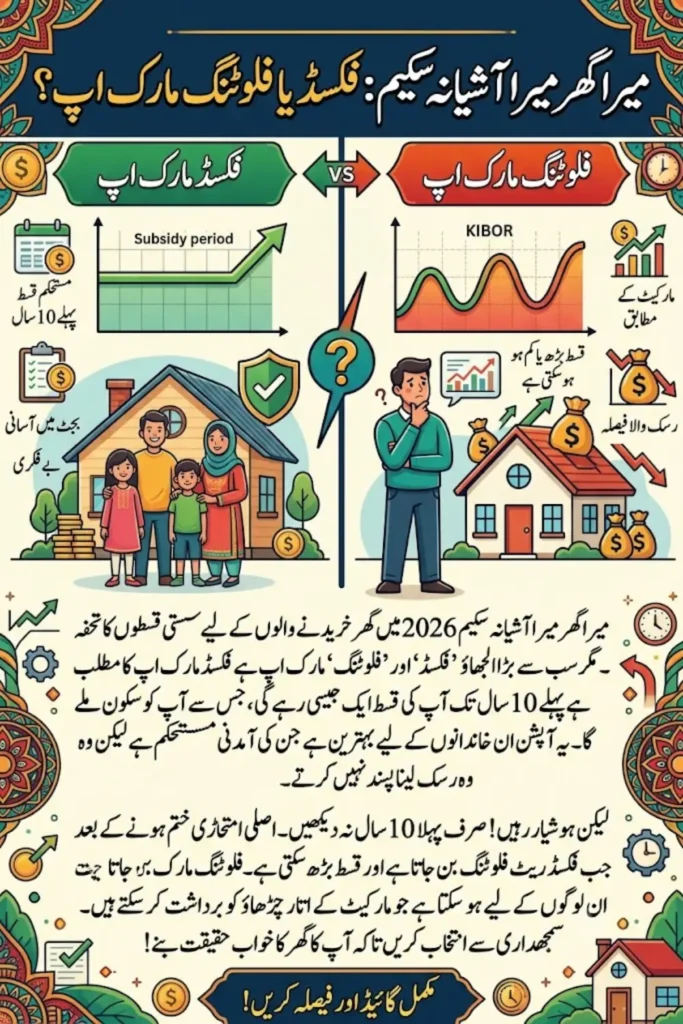
Fixed vs Floating in Mera Ghar Mera Ashiana: The Real Difference
Here is an important point to understand — the MGMA scheme itself is built mainly on a fixed-rate model, at least during the first 10-year subsidy window. But what happens after that fixed period ends is really where the big decision lies.
| Aspect | Fixed Markup (Subsidy Period) | Floating Markup (Post-Subsidy) |
|---|---|---|
| Rate | 5% or 8% (depending on tier) | 1-Year KIBOR + margin (e.g., +3%) |
| Duration | First 10 years | Remaining years after year 10 |
| Instalment stability | Completely fixed, no change | Can change with every revision |
| Risk level | Low risk | Higher risk (tied to the market) |
| Best for | Budget-conscious families with steady income | Borrowers who want to benefit if rates fall |
A Practical Example
Suppose you take a loan of PKR 2 million at a 5% fixed rate, with a 20-year tenure.
- First 10 years: Your instalment is calculated at a fixed 5% markup — this would be fairly affordable, roughly PKR 13,000 to 15,000 per month (confirm the exact figure using your bank’s calculator).
- Year 11 to year 20: If, at that time, 1-year KIBOR is around 11% and the bank’s margin is +3%, your rate becomes 14% — which would significantly increase your monthly instalment.
This is exactly where many borrowers get caught off guard, because they only look at the first 10 years’ numbers when deciding to take the loan.
Also Read: Can Overseas Pakistanis Apply for Mera Ghar Mera Ashiana Scheme 2026? Complete Guide for NRPs
Which Option Is Better for You?
This decision depends entirely on your financial situation and how much risk you are comfortable taking. Here are some scenarios to help you decide.
Choose a Fixed Markup If:
- Your income is stable but unlikely to grow much (for example, a fixed government salary).
- You do not like taking risks and prefer predictable monthly budgeting.
- You are a first-time home buyer and are not fully confident about how the loan process works.
- You want your instalment to stay fixed during the early years when family expenses (like raising young children) tend to be high.
Consider a Floating Markup If:
- Your income is likely to grow significantly over time (for example, if you work in the private sector with strong promotion prospects).
- You are financially informed and are comfortable tracking KIBOR trends.
- You have an emergency fund that can absorb higher instalments if rates rise.
- You are taking a shorter loan tenure, where the impact of rate changes is smaller.
A Balanced Approach
Most financial advisors recommend taking full advantage of the MGMA fixed subsidised rate while it lasts, since it is much lower than market rates. The real planning should begin before the subsidy period ends:
- Before taking the loan, ask your bank exactly what formula will apply once the subsidy period ends.
- Try to save a little extra every year so you are prepared if your rate increases after year 10.
- Ask your bank if you can make partial prepayments during the subsidy period to reduce your principal — this will automatically lower your instalment after the subsidy ends.
- Always compare both scenarios (fixed and floating) using your bank’s official loan calculator before applying.
Also Read: Mera Ghar Mera Ashiana Scheme 2026 Monthly Installment Calculator with Payment Examples
Eligibility for Mera Ghar Mera Ashiana
Before applying, check these basic requirements:
- You must be a Pakistani citizen with a valid CNIC.
- Neither you nor your spouse should already own a residential property in Pakistan.
- You must have a verifiable, stable income (both salaried and self-employed applicants are eligible).
- The property must fall within the scheme’s size limit (a 5 Marla house or a flat within the defined square footage).
- You must be able to submit the required documents, such as CNIC copies, income proof, bank statements, and property papers.
How to Apply
- Choose a bank: Select from participating banks such as HBL, UBL, MCB, Bank Alfalah, Meezan Bank, NBP, or HBFCL.
- Check your eligibility: Confirm your eligibility with the bank branch or through their website.
- Use the loan calculator: Estimate your monthly instalment and check what you can comfortably afford.
- Submit your documents: CNIC, income proof, residence proof, property documents, and an affidavit confirming you do not already own a home.
- Wait for approval: Verification, valuation, and legal checks usually take 2 to 6 weeks.
- Sign the agreement: Read the loan terms carefully, especially how long the fixed rate applies and what formula kicks in afterward, before signing anything.
Also Read: Mera Ghar Mera Ashiana Loan Approval Process 2026: How Long Does Bank Verification Take?
FAQs
Q1: Does the Mera Ghar Mera Ashiana scheme offer a fixed rate for the entire loan tenure?
No. The fixed subsidised rate (5% or 8%) only applies for the first 10 years. After that, the rate typically switches to a floating rate based on KIBOR, depending on the bank’s policy.
Q2: If I don’t want a floating rate later, can I refinance before that happens?
Most banks allow early repayment or refinancing, but the terms and charges vary from bank to bank. Always confirm this with your bank before taking the loan.
Q3: How much can the rate increase after 10 years?
This depends on where KIBOR stands at that time. If KIBOR is high, as it has been in 2026 (around 11-12%), your effective rate could reach 14% or more.
Q4: Can I make partial payments to reduce my loan tenure or instalment?
Yes, most banks allow partial prepayment. This reduces your principal amount, which also lowers your instalment once the subsidy period ends.
Q5: Which banks offer Mera Ghar Mera Ashiana?
HBL, UBL, MCB, Bank Alfalah, Meezan Bank, National Bank of Pakistan, Standard Chartered, and House Building Finance Company Limited (HBFCL) are among the major participating institutions.
Q6: Can self-employed people apply too?
Yes. Self-employed applicants can apply by submitting business bank statements, tax returns, or other income proof.
Final Thoughts
The Mera Ghar Mera Ashiana scheme is a golden opportunity for millions of Pakistani families who want to build their own home but have been held back by high market interest rates. A fixed markup gives you stability and peace of mind in the early years, but the smart move is to also plan ahead for the floating-rate period that follows once the subsidy ends.
Before signing your loan, make sure you fully understand the post-subsidy terms from your bank, compare both scenarios using their calculator, and think about your family’s long-term financial situation before making a final decision. In the end, this isn’t just a loan — it’s a decision about your home and your future.
Also Read: Who Can Apply for Mera Ghar Scheme 2026? Complete Eligibility Guide