Interest-Free vs Markup Housing Schemes in Pakistan 2026: Which One Is Right for You?

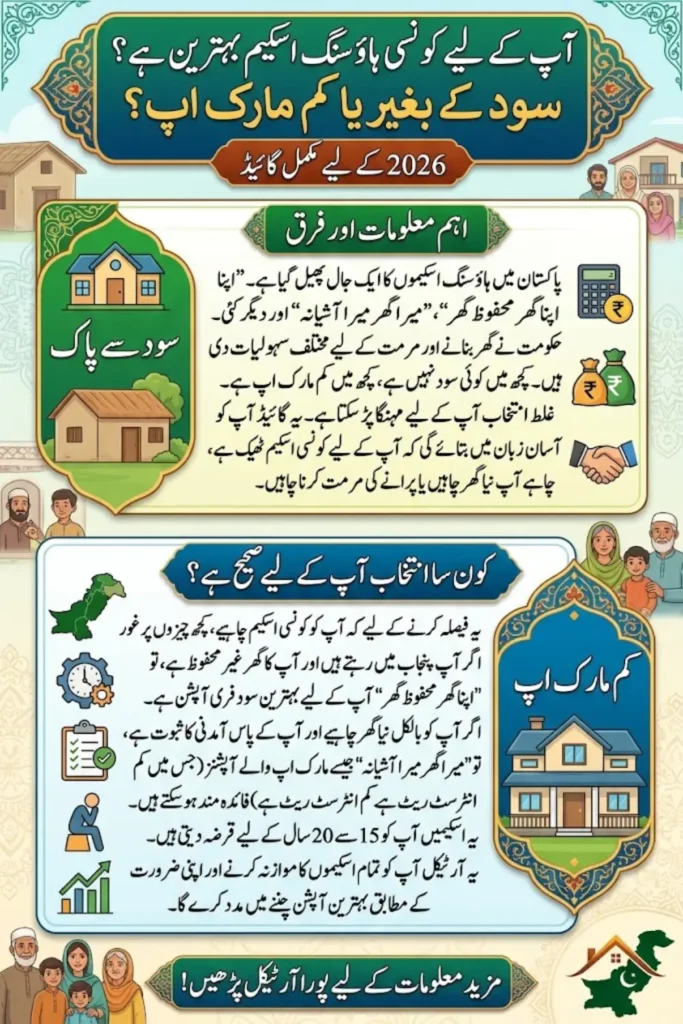
If you’ve been searching for a government housing loan in Pakistan lately, you’ve probably noticed something confusing: there isn’t just one scheme anymore. There’s Mera Ghar Mera Ashiana, PM Apna Ghar Programme, Apni Chhat Apna Ghar, and now Apna Ghar Mehfooz Ghar too. Some of these are completely interest-free. Others charge a markup, even if it’s subsidized. Picking the wrong one — or not understanding the difference — can cost you a lot over the years. This guide breaks it all down in simple terms, so you can figure out exactly which scheme matches your situation.
Why There Are So Many Housing Schemes Right Now
Pakistan faces a housing shortfall of more than 10 million units, and both the federal and provincial governments are trying to close that gap from different angles. The federal government, working with the State Bank of Pakistan (SBP), focuses on subsidized bank financing for buying or building homes. The Punjab government, on the other hand, runs its own interest-free loan programs aimed specifically at low-income and vulnerable families, including emergency repairs for unsafe homes.
The result is a mix of schemes that serve different income groups and different needs. Understanding which bucket each scheme falls into is the first step to choosing correctly.
Also Read: Mera Ghar Mera Ashiana vs PM Apna Ghar vs Apni Chhat Apna Ghar Which One Is Right for You?
The Two Types of Government Housing Support
Before comparing individual schemes, it helps to understand the two broad categories they fall into.
Type 1: Interest-Free (Qarz-e-Hasna Style) Schemes
These are provincial government schemes, mainly run by the Punjab government through the Bank of Punjab and PHATA. You borrow a fixed amount and repay only the principal — no markup, no interest, no KIBOR-linked charges at all.
Type 2: Subsidized Markup Schemes
These are federal schemes run through commercial and Islamic banks, backed by SBP and the federal government. You still pay a markup (interest), but at a heavily reduced, government-subsidized rate compared to a normal bank loan.
Also Read: Apni Chhat Apna Ghar & Apni Zameen Apna Ghar: Punjab Progress Update 2026
Scheme-by-Scheme Comparison
Here’s how the major schemes currently active in Pakistan compare side by side:
| Scheme | Type | Maximum Loan | Markup/Interest | Best For |
|---|---|---|---|---|
| Mera Ghar Mera Ashiana | Subsidized markup | Up to Rs. 10 million | 5% flat rate | Buying/building a house or flat (up to 10 Marla / 1,500 sq ft) |
| PM Apna Ghar Programme | Subsidized markup | Up to Rs. 10 million (banks & NBFCs) | 5% for first 10 years, then market-linked | Nationwide new home construction, wider access via banks and NBFCs |
| Apni Chhat Apna Ghar | Interest-free | Up to Rs. 1 million (recently expanded) | 0% (interest-free) | Low-income and homeless families in Punjab |
| Apna Ghar Mehfooz Ghar | Interest-free | Rs. 500,000 (repair) / Rs. 1 million (extra floor) | 0% (interest-free) | Repairing unsafe/weak-roof homes in Punjab |
Interest-Free Schemes: What You Need to Know
Apni Chhat Apna Ghar
This is Punjab’s flagship interest-free housing scheme, run in partnership with the Bank of Punjab and PHATA. It has already disbursed loans to around 170,000 families, with a target to reach 100,000 more households in the coming fiscal year. It’s designed for people who don’t own a home at all — including homeless families and those living in temporary or unsafe housing.
Apna Ghar Mehfooz Ghar
Launched after the tragic roof collapse in Kahna, this program sits under the broader Apni Chhat Apna Ghar umbrella but targets a different need: fixing homes that already exist but are dangerous to live in. If your roof is weak or your structure is deteriorating, this scheme offers an interest-free loan specifically for repair and reinforcement, or for adding a safe additional floor.
Who should consider these:
- Families with little to no reliable income who cannot afford even subsidized bank markup
- Homeless families or those in temporary shelters
- Homeowners whose existing house is structurally unsafe
Also Read: Apna Ghar Mehfooz Ghar Scheme 2026: Get Rs 5 Lakh Loan for Home Repair
Subsidized Markup Schemes: What You Need to Know
Mera Ghar Mera Ashiana
This is the federal government’s main housing finance scheme, delivered through commercial and Islamic banks. As of the 2026 revision, the loan limit was raised to Rs. 10 million with a flat 5% markup rate, covering houses up to 10 Marla or flats up to 1,500 sq. ft. It works well for salaried and self-employed individuals with a documented, stable income.
PM Apna Ghar Programme
This is a much larger, nationwide initiative — a five-year, Rs. 3.2 trillion plan targeting 500,000 new homes across Pakistan, including AJK and Gilgit-Baltistan. A key 2026 update allows Non-Banking Finance Companies (NBFCs) and microfinance companies to offer these loans too, not just traditional banks. This matters a lot for people who don’t have an existing bank relationship or live in areas with limited bank branches, since NBFCs and microfinance companies often have wider reach.
Who should consider these:
- Salaried employees and business owners with proof of income
- People planning to buy a completed house/flat or construct on land they already own
- Applicants who can manage a modest, subsidized monthly installment over 15–20 years
Also Read: Apni Chhat Apna Ghar Scheme 2026: Latest Progress & How to Check Your Application Status
Side-by-Side: Eligibility Snapshot
| Requirement | Interest-Free Schemes | Markup-Based Schemes |
|---|---|---|
| Income proof needed | Minimal or relaxed | Yes, salary slip or business income proof required |
| First-time homeowner required | Usually yes | Usually yes |
| Repayment method | Fixed installments, no interest | EMI including subsidized markup |
| Application channel | Bank of Punjab / PHATA | Participating banks, and now NBFCs/microfinance companies |
| Best suited region | Punjab only (for now) | Nationwide |
How to Decide Which Scheme Fits You
Ask yourself these three questions:
- Do I already own a home, or need to repair one? If your existing home is unsafe, Apna Ghar Mehfooz Ghar is built exactly for that. If you’re homeless or have no housing unit at all, look at Apni Chhat Apna Ghar first.
- Do I have a stable, documented income? If yes, you’re a strong candidate for markup-based schemes like Mera Ghar Mera Ashiana or PM Apna Ghar, since banks will require income verification.
- Am I based in Punjab, or elsewhere in Pakistan? Interest-free schemes are currently Punjab-specific. If you live outside Punjab, your realistic options are the federal markup-based schemes.
Also Read: Apni Chhat Apna Ghar Scheme 2026 Rs. 10 Lakh Interest-Free Loan Guide
Frequently Asked Questions
Can I apply for more than one scheme at the same time?
Generally no. Most schemes require you to confirm you don’t already own a housing unit or haven’t availed similar government financing elsewhere. Applying for multiple overlapping schemes can lead to disqualification from both.
Is 5% markup really that much cheaper than a normal bank loan?
Yes, significantly. Regular commercial housing loans in Pakistan are typically linked to KIBOR plus a margin, which has been well above 12% in recent months. A flat 5% subsidized rate is a major saving over the life of a 15–20 year loan.
Are interest-free schemes only for extremely poor families?
They’re primarily targeted at low-income, homeless, or vulnerable households, but eligibility criteria vary by scheme. It’s best to check the specific income and documentation requirements for Apni Chhat Apna Ghar or Apna Ghar Mehfooz Ghar directly with PHATA or the Bank of Punjab.
Which scheme has the highest loan amount available?
As of 2026, Mera Ghar Mera Ashiana and PM Apna Ghar Programme both offer up to Rs. 10 million, making them the largest financing options — but they come with a markup, unlike the smaller interest-free schemes.
Do these schemes cover plot purchase as well as construction?
Most of the markup-based schemes (Mera Ghar Mera Ashiana, PM Apna Ghar) cover buying a house/flat, buying a plot and building on it, or constructing on land you already own. The interest-free Punjab schemes are more narrowly focused on home repair, additional floors, or providing homes to families without one.
Also Read: Fake Housing Societies in Pakistan: How the New SECP Registration Rules Aim to Protect You in 2026