Affordable Housing Finance Scheme 2026 – 5% Markup, Rs. 10 Million Loan Guide

Affordable Housing Finance Scheme Pakistan 2026
Owning a home has become harder and harder for ordinary Pakistani families as property prices keep climbing faster than incomes. To make homeownership realistic again, the federal government runs the Markup Subsidy and Risk Sharing Scheme, better known by its public name, Mera Ghar–Mera Ashiana. In March 2026, the government approved a major expansion of this program, and the changes are significant enough that even people who checked the scheme’s rules a year ago should read the updated terms.
Here’s a complete, accurate breakdown of how the scheme works today.
Also Read: PM Apna Ghar Programme 2026: How to Get a Loan from NBFCs (Step-by-Step Guide)
What Changed in the March 2026 Update
The Ministry of Housing and Works, acting on a decision by the Economic Coordination Committee (ECC) and the federal cabinet, revised the scheme through a State Bank of Pakistan (SBP) circular dated 17 March 2026. The three biggest changes were:
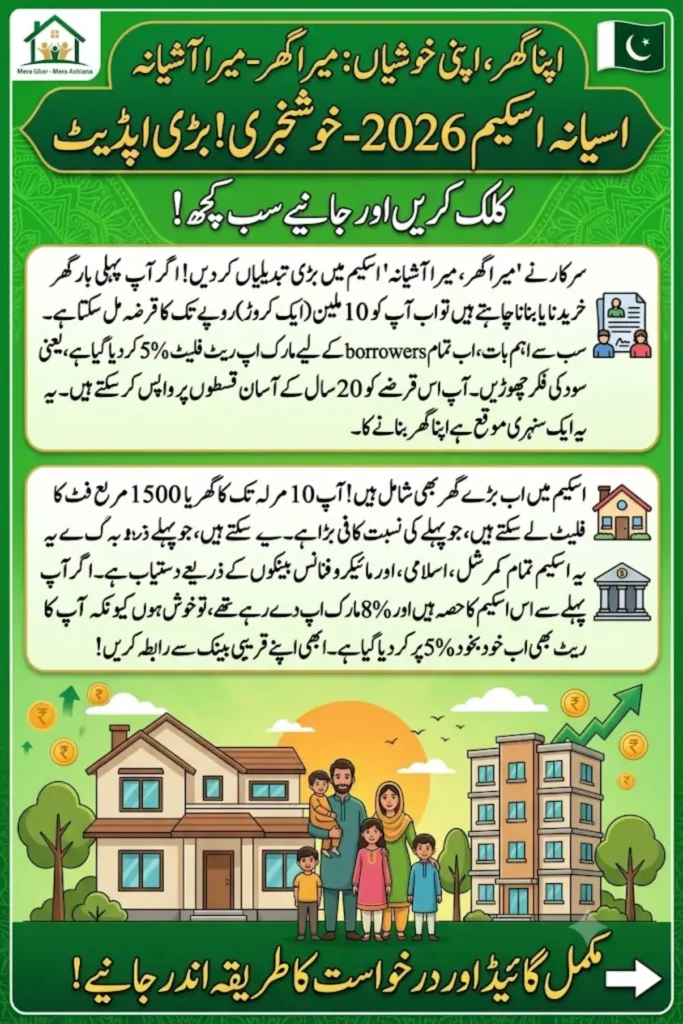
- Loan limit raised from Rs. 3.5 million to Rs. 10 million
- Markup rate standardized to a flat 5% for all borrowers (previously, one borrower category paid 8% while another paid 5%)
- Eligible property size doubled — houses up to 5 Marla are now houses up to 10 Marla (2,720 sq. ft.), and apartments increased from 1,360 sq. ft. to 1,500 sq. ft.
That last point matters a lot, and it’s one of the most commonly misreported details online. Many older articles still list 5 Marla as the maximum house size — that limit was doubled in this update, so don’t rule yourself out based on outdated size restrictions.
What Is the Affordable Housing Finance Scheme?
At its core, this is a government-backed subsidy program, not a separate government loan. The government doesn’t lend you money directly — instead, it works with regular banks and pays down part of the interest cost on your behalf, while also absorbing some of the bank’s lending risk. This is why banks are willing to offer such low rates to borrowers who might not otherwise qualify for conventional housing finance.
The scheme covers four common housing needs:
- Buying a ready-built house
- Buying a flat or apartment
- Constructing a house on a plot you already own
- Buying a plot and building on it afterward
It’s implemented by the State Bank of Pakistan in partnership with the Pakistan Housing Authority-Foundation, and rolled out through commercial banks, Islamic banks, microfinance banks, and the House Building Finance Company Limited (HBFCL).
Also Read: Interest-Free vs Markup Housing Schemes in Pakistan 2026: Which One Is Right for You?
Who Can Apply?
Eligibility rules were kept unchanged in the 2026 revision. To qualify, you must:
- Be a Pakistani citizen with a valid CNIC or NICOP
- Be a first-time homeowner — meaning you don’t currently own any residential property anywhere in Pakistan
- Provide an undertaking confirming your first-time buyer status
- Meet the bank’s standard income and credit-history checks
Priority tends to go toward:
- Salaried individuals with a steady, verifiable income
- Families currently living in rented accommodation
- Applicants planning to build on land they already own
Because eligibility is verified against your CNIC and property records, providing accurate information matters false declarations can lead to rejection or disqualification later in the process.
Also Read: PM Apna Ghar Programme 2026 – Rs. 3.2 Trillion, 5 Lakh Ghar Plan
Property Size Limits (Updated 2026)
| Property Type | Maximum Size Allowed (2026) | Previous Limit |
|---|---|---|
| House | Up to 10 Marla (2,720 sq. ft.) | Up to 5 Marla |
| Flat / Apartment | Up to 1,500 sq. ft. | Up to 1,360 sq. ft. |
This expansion was introduced specifically to bring middle-income families into the scheme, since a 5-Marla house in most major cities had become nearly impossible to build within the previous loan ceiling.
Loan Structure: What You’ll Actually Pay
| Loan Feature | Detail |
|---|---|
| Maximum Loan Amount | Up to Rs. 10 million |
| Borrower’s Fixed Markup Rate | 5% (flat, for all borrowers) |
| Bank’s Pricing Basis | 1-Year KIBOR + 3% |
| Government Subsidy Period | First 10 years of the loan |
| Maximum Loan Tenure | Up to 20 years |
| Loan-to-Value Ratio | 90:10 (bank finances 90%, borrower contributes 10%) |
| Processing Fee | None |
| Prepayment Penalty | None |
In simple terms: even though the bank technically prices the loan much higher based on KIBOR, you as the borrower only pay the fixed 5% rate — the government covers the difference for the first 10 years. After that period, the loan reverts to the bank’s standard pricing structure for the remaining tenure.
Relief for Existing Borrowers
If you took a loan under the older version of this scheme and were paying the higher 8% markup rate (which previously applied to one borrower tier), that rate has now been automatically adjusted down to 5%, matching new applicants. This change was applied directly by SBP instruction, so eligible existing borrowers shouldn’t need to reapply — check with your bank if your statement hasn’t reflected the new rate yet.
How to Apply
- Choose a participating bank — commercial banks, Islamic banks, microfinance banks, and HBFCL are all authorized to offer this scheme.
- Submit the relevant application form at a bank branch (salaried applicants and self-employed/business applicants typically use different forms).
- Provide required documents, including CNIC, income proof, and details of the property or construction plan.
- Bank verification — the bank will physically verify your residence, workplace, and the selected property before approval.
- Property mortgage and disbursement — once the property title is cleared and mortgaged in the bank’s favor, funds are released either to the seller directly or in stages for construction projects.
There’s no application fee for this scheme, and no penalty if you choose to pay off your loan early.
The Bigger Picture: Program Targets and Progress
This isn’t a small pilot project. The government has set a four-year target to finance 500,000 housing units, structured as:
- 50,000 units in FY 2025–26
- 100,000 units in FY 2026–27
- 150,000 units in FY 2027–28
- 200,000 units in FY 2028–29
To support just the first 50,000 units, the government has allocated a total subsidy of roughly Rs. 321.96 billion, covering both markup subsidies and risk-sharing costs.
As of the most recent official update (end of April 2026), the scheme had received over 25,000 applications nationwide, with nearly 9,000 already approved and financing worth more than Rs. 37 billion sanctioned. It’s a program that’s genuinely moving, not just a policy announcement sitting on paper.
Also Read: Interest-Free vs Markup Housing Schemes in Pakistan 2026: Which One Is Right for You?
Role of the State Bank of Pakistan
SBP isn’t just a bystander here — it’s the scheme’s implementing and supervisory authority. Its responsibilities include:
- Issuing and updating scheme circulars and guidelines
- Supervising all participating financial institutions
- Monitoring loan disbursement and subsidy usage
- Coordinating with the Ministry of Housing and Works and the Pakistan Housing Authority-Foundation
This oversight is meant to keep the scheme transparent and reduce the risk of misuse, particularly given the scale of public funds involved.
Also Read: Apni Chhat Apna Ghar Scheme 2026 Rs. 10 Lakh Interest-Free Loan Guide
Things to Keep in Mind Before Applying
- You must genuinely be a first-time homeowner. Owning any residential property, even a small one, disqualifies you.
- Loan approval still depends on your income and credit history — the subsidy lowers your rate, but it doesn’t remove the bank’s normal lending checks.
- Only work with authorized banks and verified property projects. Always confirm a project’s approval status before making any payment.
- The subsidy period is 10 years, not the full loan term. Budget for the possibility of a rate change once the subsidy period ends and the loan reverts to standard bank pricing.
Also Read: Fake Housing Societies in Pakistan: How the New SECP Registration Rules Aim to Protect You in 2026
Frequently Asked Questions (FAQs)
What is the Affordable Housing Finance Scheme Pakistan 2026?
It’s a government-backed program, officially called the Markup Subsidy and Risk Sharing Scheme (branded as Mera Ghar–Mera Ashiana), that helps first-time home buyers get housing loans at a fixed 5% markup instead of standard bank rates.
What is the maximum loan amount available?
Up to Rs. 10 million, depending on the property value and the bank’s assessment of your eligibility.
What size of house or flat qualifies?
Houses up to 10 Marla (2,720 sq. ft.) and flats or apartments up to 1,500 sq. ft. — both limits were increased from the previous restrictions in March 2026.
Who can apply for this scheme?
Pakistani citizens with a valid CNIC or NICOP who do not currently own any residential property and meet the participating bank’s income and credit requirements.
What markup rate will I actually pay?
A fixed 5%, regardless of which borrower tier you previously fell under. The government subsidizes the difference between this rate and the bank’s actual KIBOR-based pricing for the first 10 years.
I already have a loan under this scheme at 8% — do I need to reapply for the lower rate?
No. SBP instructed banks to automatically adjust existing 8% loans down to 5%. Contact your bank if this hasn’t been reflected in your account yet.
Is there a processing fee or penalty for early repayment?
No. The scheme has no application processing fee and no prepayment penalty.
How much do I need to contribute as a down payment?
At least 10% of the property value, since the scheme operates on a 90:10 loan-to-value ratio.
Which banks offer this scheme?
All commercial banks, Islamic banks, microfinance banks, and the House Building Finance Company Limited (HBFCL) are authorized participating institutions.
Also Read: Apni Chhat Apna Ghar Scheme 2026: Latest Progress & How to Check Your Application Status
Final Thoughts
The 2026 update to Pakistan’s Affordable Housing Finance Scheme is one of the most meaningful improvements this program has seen — a bigger loan ceiling, a genuinely fixed low markup rate, and property size limits that finally reflect what families actually need to build a livable home. If you’re a first-time buyer who assumed you didn’t qualify under the old 5-Marla or Rs. 3.5 million limits, it’s worth checking again with your bank — the rules have changed significantly in your favor.
Also Read: PM Apna Ghar Programme 2026: How to Get a Loan from NBFCs (Step-by-Step Guide)