BISP 8171 Phase-2 2026 Rs 13,500 District-Wise Payment Release Now Started

BISP Phase-2 Payment 2026
Every quarter, BISP doesn’t release the Benazir Kafalat installment to the whole country in one go. Instead, payments roll out in stages, district by district — something beneficiaries often refer to as “phases.” If you’ve been hearing about “BISP Phase-2 payments” and want to know what it actually means for your installment, this guide breaks it down clearly.
First, an Important Correction: The Payment Amount Has Changed
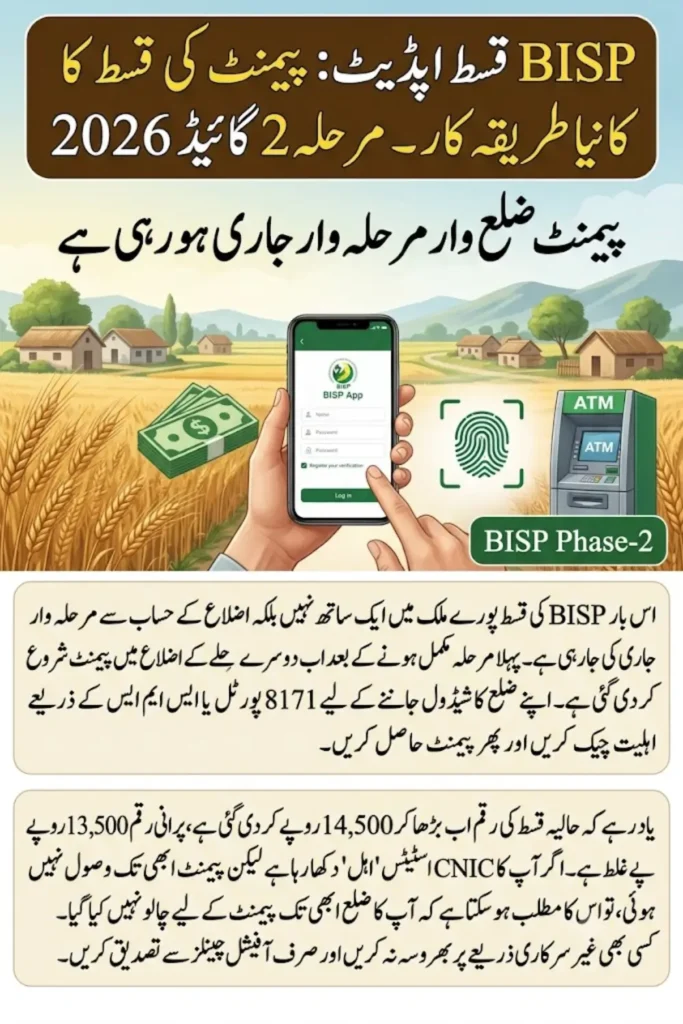
Many older guides still quote the Kafalat installment as Rs. 13,500. That figure is outdated. Earlier in 2026, BISP Chairperson Senator Rubina Khalid announced an increase to Rs. 14,500 per quarter, effective from the Ramzan 2026 cycle onward. This is the amount currently being disbursed, including in the ongoing July–September 2026 cycle. So if your CNIC check still shows Rs. 13,500 anywhere, treat that as old information, not your actual current entitlement.
Looking further ahead, the federal government has also approved a bigger jump to Rs. 19,500 per quarter — but that change only takes effect from January 2027, so it doesn’t apply to payments being released right now.
Also Read: BISP Payment 2026 District-Wise Disbursement List & CNIC Status Check Now Live
What Does “Phase-2” Actually Mean?
BISP doesn’t release funds to all 9+ million beneficiary families simultaneously. Instead, the disbursement moves through the country in rounds, grouped loosely by district and region. When people say “Phase-1” or “Phase-2,” they’re usually referring to which batch of districts has entered active payment release.
This staggered rollout exists mainly to:
- Prevent overcrowding at payment centers and ATMs
- Give the verification system time to process biometric checks in manageable batches
- Allow BISP field teams to resolve local issues (like NSER data mismatches) before mass disbursement
If your district hasn’t opened for the current cycle yet, your CNIC status will usually show as “pending” rather than an error — it simply means your batch hasn’t come up yet.
Who Qualifies for the Current Payment?
To receive the ongoing quarterly installment, a household generally needs to meet these conditions:
- Registered in the BISP database with an active case
- PMT score below 32
- Applicant is the female head of household
- Valid, biometrically-enabled CNIC
- Completed the NSER Dynamic Survey
- No conflicting benefit from a duplicate program (unless specifically permitted)
- Not employed in a government position, and without large disqualifying assets
If your household’s income or assets have improved since your last survey, your PMT score may rise above the threshold, which can lead to automatic removal from the active list at the next data refresh.
Also Read: BISP Digital Wallet 2026 Receive Payments Securely via Easypaisa & JazzCash Integration
How to Check Your CNIC Status
There are two simple, official ways to check whether your payment is ready:
SMS Method
- Open your phone’s messaging app
- Type your 13-digit CNIC number (no dashes or spaces)
- Send it to 8171
- Wait for the automatic reply with your status
Online Portal Method
- Go to 8171.bisp.gov.pk
- Enter your CNIC number
- Complete the captcha
- Click submit to view your eligibility and payment details
Both channels draw from the same live BISP database, so you’ll get the same result either way — the SMS option is just handy if you don’t have reliable internet access.
Where to Collect Your Payment
Once your status shows as ready for collection, you can withdraw your installment through any of the following:
- HBL Konnect payment centers — biometric verification required, available nationwide
- Bank Alfalah partner retailers — CNIC plus thumb verification
- Selected ATMs — CNIC and biometric confirmation, then follow the on-screen BISP withdrawal option
- Digital wallets (JazzCash / Easypaisa) — available only for beneficiaries specifically enrolled in the digital payment option; this method has been expanding in parts of Punjab through 2026
No retailer, agent, or bank representative is allowed to deduct any charge from your payment. If someone asks for money to “process” or “release” your installment, that’s a scam — report it rather than pay.
Documents to Bring
- Original CNIC (biometric-enabled)
- Mobile number registered against your CNIC
- 8171 confirmation SMS, if you received one (helpful, not always required)
- For beneficiaries with disabilities: a nominated, authorized family member may collect on their behalf, subject to the center’s verification rules
Why Some Beneficiaries See Delays
A few common reasons payments get held up:
| Issue | What It Means | What to Do |
|---|---|---|
| District not yet active | Your area hasn’t reached its scheduled release batch | Recheck status every few days |
| “Under Verification” status | NSER record needs updating | Visit your BISP Tehsil Office |
| Biometric fails at center | Fingerprint doesn’t match NADRA record | Get biometric re-verification done |
| Status shows “Not Eligible” | PMT score above threshold or asset mismatch | Request a review at your Tehsil Office |
Staying Safe During Phased Disbursement
Because payments roll out gradually, this period tends to attract scam messages pretending to offer “early release” or “priority processing.” Keep these points in mind:
- 8171 is the only official BISP number. Anything else claiming to represent BISP should be treated as suspicious.
- Never share your CNIC, OTP, or bank details over the phone or WhatsApp with unknown contacts.
- BISP payments and status checks are completely free — no exceptions.
- Always confirm your status through the official portal or SMS before traveling to a payment center.
Frequently Asked Questions (FAQs)
How much is the current BISP payment in 2026?
The quarterly Kafalat installment is currently Rs. 14,500, covering the July–September 2026 cycle. Older figures showing Rs. 13,500 are outdated.
What does “BISP Phase-2” mean exactly?
It refers to a batch of districts scheduled to receive their quarterly payment during a specific stage of the phased, district-wise rollout — not a separate program or a one-time special payment.
How do I know if my district is in the current phase?
Check your CNIC status through the 8171 portal or SMS. If your district hasn’t opened yet, your status will typically show as pending rather than an error.
Can I collect payment through a mobile wallet?
Yes, but only if you’ve specifically been enrolled in the digital wallet option through JazzCash or Easypaisa. Otherwise, use an authorized bank, retailer, or ATM.
Is there a fee to collect my BISP payment?
No. The service is completely free. Never pay anyone claiming to speed up or guarantee your payment.
What should I do if my status shows “Not Eligible”?
Visit your nearest BISP Tehsil Office with your CNIC to request a review, especially if you believe your PMT score or asset information is incorrect.
Can I check my PMT score through the 8171 portal?
No. PMT scores aren’t available online. You’ll need to visit your Tehsil Office in person for a verification slip.
Final Thoughts
BISP’s phased, district-wise approach to releasing payments is designed to keep the process organized and reduce crowding, not to delay anyone unfairly. Keep your CNIC and NSER details updated, check your status through official channels before heading to a payment center, and always collect your installment from an authorized source only.
Also Read: BISP 8171 Double Payment 2026 Check Rs. 27,000 Release Status via CNIC Online