Apna Ghar Mehfooz Ghar vs Bank Loan – Which Is Better in 2026?

If your home needs urgent repair a weak roof, cracked structural walls, or you simply want to add another floor — you have two broad paths to fund it: apply for the government’s interest-free Apna Ghar Mehfooz Ghar scheme, or take out a conventional home improvement loan from a commercial bank. On paper, “interest-free” sounds like the obvious winner, but the real answer depends on your specific situation. Here’s an honest, practical comparison to help you decide.
Quick Overview: The Two Options
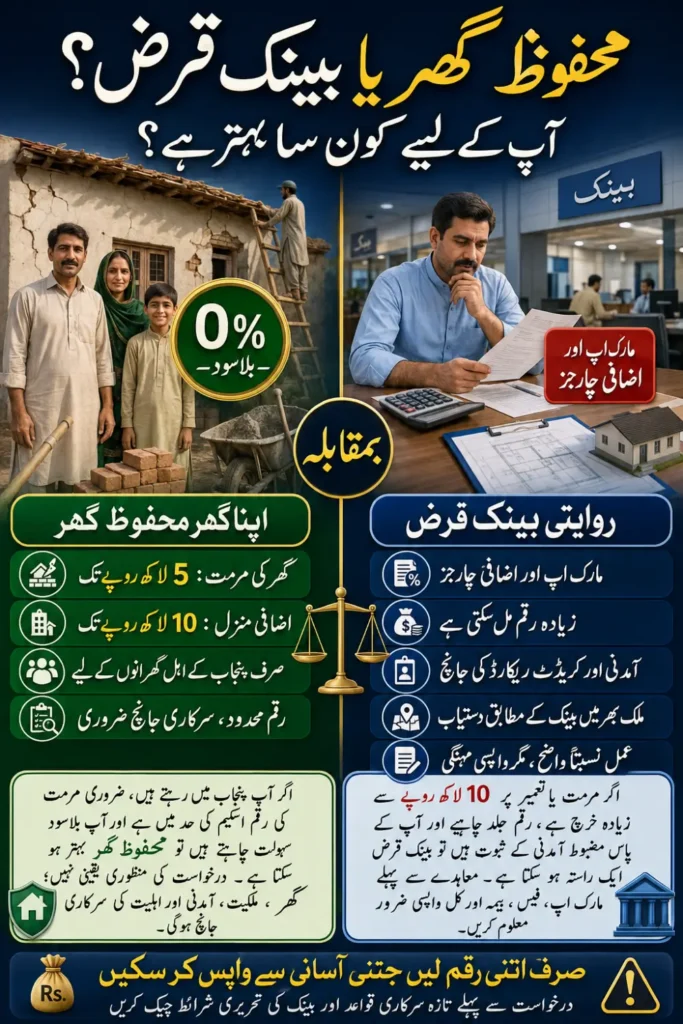
| Feature | Apna Ghar Mehfooz Ghar | Traditional Bank Loan |
|---|---|---|
| Interest/Markup | 0% (interest-free) | Typically 15–22%+ depending on the bank |
| Maximum amount | Rs. 500,000 (repair) / Rs. 1 million (additional floor) | Varies by bank, often higher limits available |
| Eligibility basis | Need-based (property condition, income level) | Credit history, income verification, Debt Burden Ratio |
| Processing speed | Still being finalized as a newer scheme | Generally well-established, faster in many banks |
| Administering body | PHATA / Bank of Punjab | Any commercial or Islamic bank |
| Documentation complexity | Lower — no complex credit assessment | Higher — full income and credit checks required |
| Availability | Punjab residents only | Nationwide, wherever the bank operates |
Apna Ghar Mehfooz Ghar: The Case For It
It’s Genuinely Interest-Free
This is the single biggest advantage. Over a multi-year repayment period, even a “low” bank markup rate adds up to a significant amount paid on top of your principal. With Mehfooz Ghar, you repay only what you borrowed — nothing more.
No Complex Credit Assessment
Traditional bank loans typically require a Debt Burden Ratio (DBR) calculation, proof of stable income, and sometimes an existing credit history. Mehfooz Ghar is structured around your home’s condition and general eligibility criteria rather than a conventional credit profile, which makes it more accessible if you’re self-employed, have irregular income, or don’t have an established banking relationship.
Built on Existing, Proven Infrastructure
Since Mehfooz Ghar operates under the same framework as Apni Chhat Apna Ghar — a programme that has already served around 170,000 families — the administrative system behind it isn’t new or untested, even though this specific repair-focused component is newer.
Also Read: PM Apna Ghar Programme 2026: How to Get a Loan from NBFCs (Step-by-Step Guide)
Apna Ghar Mehfooz Ghar: The Case Against It
Lower Loan Ceiling
At a maximum of Rs. 500,000 for repairs or Rs. 1 million for an additional floor, this scheme may not cover more extensive renovation or construction needs, especially with rising material and labor costs.
Newer Component, Fewer Established Procedures
Because this specific scheme was introduced relatively recently, detailed application procedures, processing timelines, and documentation requirements are still being finalized. This can mean more uncertainty about exactly how long your application will take.
Limited to Punjab
If you live outside Punjab, this scheme simply isn’t available to you, regardless of how badly you need home repair financing.
Also Read: Apni Chhat Apna Ghar Scheme 2026: Latest Progress & How to Check Your Application Status
Traditional Bank Loan: The Case For It
Higher Borrowing Limits
If your repair or construction needs exceed Rs. 1 million, a conventional bank loan can typically offer significantly more financing, especially if you have strong income documentation.
Established, Predictable Process
Commercial banks have well-established home improvement and construction loan products with clear, published timelines, documentation checklists, and customer service processes built up over years.
Available Nationwide
Regardless of which province you live in, you can access a conventional home loan product through nearly any commercial or Islamic bank branch.
Faster Access If You Already Bank There
If you already have an account and credit history with a bank, you may find the application process smoother and faster than navigating a newer government scheme.
Also Read: Apni Chhat Apna Ghar Scheme 2026 Rs. 10 Lakh Interest-Free Loan Guide
Traditional Bank Loan: The Case Against It
The Real Cost of Markup Adds Up
Even a relatively “reasonable” bank markup rate compounds significantly over a multi-year repayment period. On a home improvement loan, this can mean paying back considerably more than what you originally borrowed.
Strict Eligibility Requirements
Banks assess your Debt Burden Ratio, income stability, and credit history closely. If you’re self-employed with irregular income, have limited credit history, or already carry other debt, you may struggle to qualify or may be offered less favorable terms.
Processing Fees and Other Charges
Unlike Mehfooz Ghar, which is designed as a straightforward interest-free facility, conventional bank loans often come with processing fees, insurance requirements, and other charges that add to the overall cost.
Also Read: PM Apna Ghar Programme 2026 – Rs. 3.2 Trillion, 5 Lakh Ghar Plan
Which One Should You Actually Choose?
Choose Apna Ghar Mehfooz Ghar If:
- You live in Punjab
- Your repair or construction need falls within the Rs. 500,000 / Rs. 1 million limits
- You don’t have strong, documented income or an established bank relationship
- Avoiding interest entirely is a priority for you, whether for religious, financial, or personal reasons
- You’re willing to work with a newer government process that may take some patience as procedures are finalized
Choose a Traditional Bank Loan If:
- Your renovation or construction costs exceed what Mehfooz Ghar can offer
- You live outside Punjab
- You already have strong income documentation and an existing banking relationship
- You need a faster, more predictable, well-established application process
- You’re comfortable managing markup payments as part of your overall budget
Also Read: Ehsaas Apna Ghar Scheme 2026: KP’s Interest-Free Housing Loan Explained
A Practical Middle-Ground Approach
For some homeowners, the smartest approach isn’t necessarily choosing one over the other — it’s using Mehfooz Ghar to cover the core safety-critical repair (like fixing a genuinely dangerous roof) within its loan limit, and separately financing any additional renovation ambitions through your own savings or a smaller supplementary loan later, rather than taking on a larger commercial loan than you actually need right now.
Also Read: Apna Ghar Mehfooz Ghar Loan – Easiest Way to Apply in 2026
Frequently Asked Questions
Is Apna Ghar Mehfooz Ghar always the cheaper option?
In terms of total repayment cost, yes — since it’s interest-free, you’ll always pay back less than an equivalent commercial loan with markup, assuming your need fits within the scheme’s loan limits.
Can I apply for both at the same time?
Generally, this isn’t advisable or typically permitted, since both are meant to finance the same underlying need. Most schemes require you to confirm you haven’t already obtained financing for the same purpose elsewhere.
What if my repair costs more than Rs. 500,000?
You have a few options: scale down the scope of repairs to fit within the loan limit, supplement the Mehfooz Ghar loan with personal savings, or consider a traditional bank loan if your needs significantly exceed the government scheme’s ceiling.
Is a bank loan faster to get approved than Mehfooz Ghar?
This can vary. Established bank products often have more predictable timelines simply because the process has existed for years, while Mehfooz Ghar’s procedures are still being finalized as a newer scheme. If speed is critical, it’s worth asking your bank directly for their current typical processing time to compare.
Do I need good credit to qualify for Mehfooz Ghar?
No, unlike a conventional bank loan, Mehfooz Ghar doesn’t rely on a traditional credit history or Debt Burden Ratio assessment in the same way — eligibility is based more on your property’s condition and general household eligibility criteria.
Can I switch from a bank loan to Mehfooz Ghar later if I already applied for one?
This depends on your specific circumstances and whether you’ve already received disbursement. It’s best to fully complete or formally withdraw from one application before pursuing the other, to avoid complications with either process.
Also Read: Apna Ghar Mehfooz Ghar Scheme 2026: Rs. 500,000 Interest-Free Loan to Repair Unsafe Homes