Lindsey Graham’s Cause of Death: What Doctors Say About His Aortic Dissection
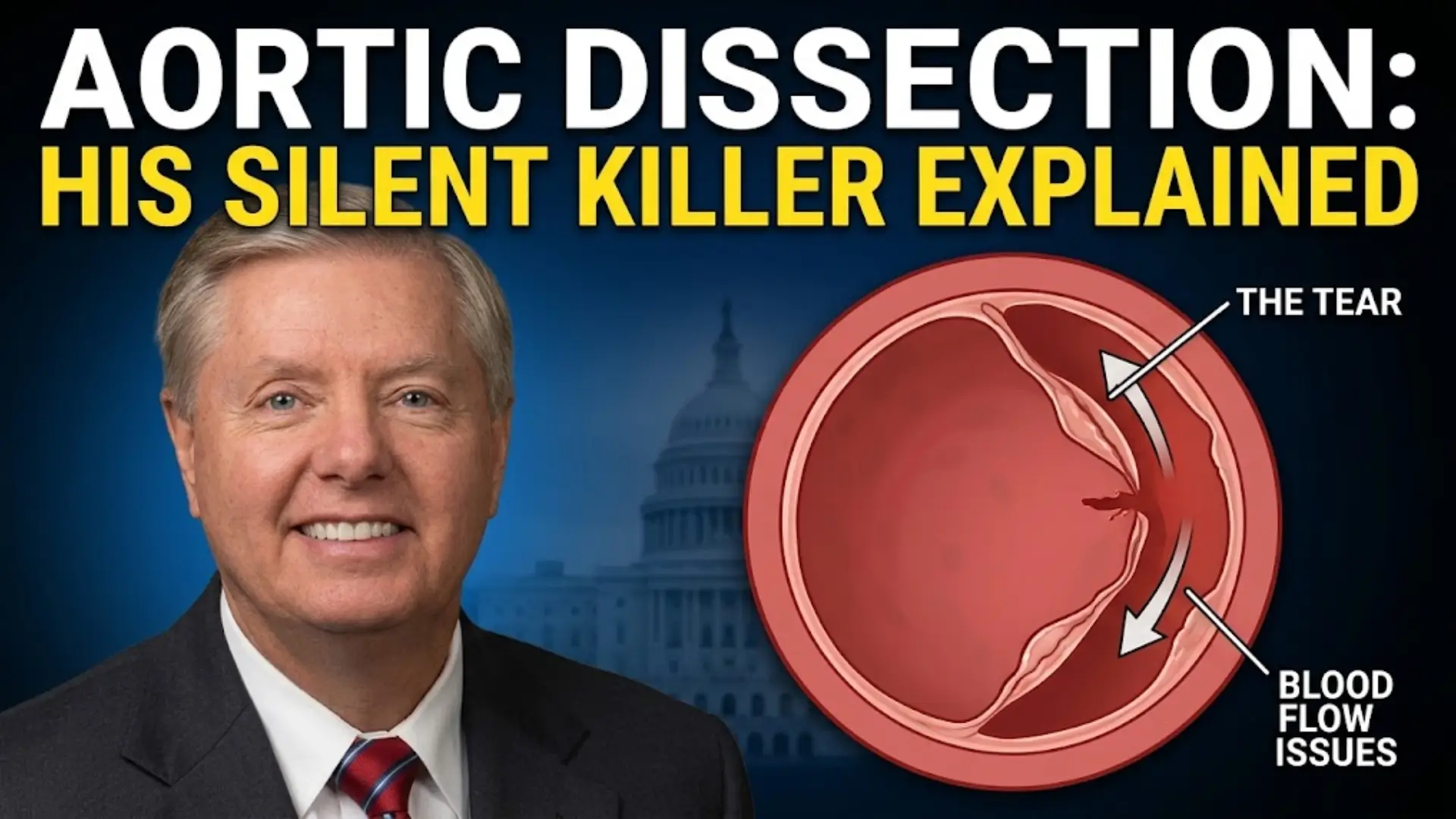
Sen. Lindsey Graham (R-South Carolina) died on July 12, 2026, at age 71. His office said the preliminary cause of death was an aortic dissection due to arteriosclerotic cardiovascular disease — in plain terms, a tear in the wall of his aorta caused by hardened, narrowed arteries. Here’s what that diagnosis means, how the night unfolded, and what’s been confirmed since.
How Lindsey Graham Died
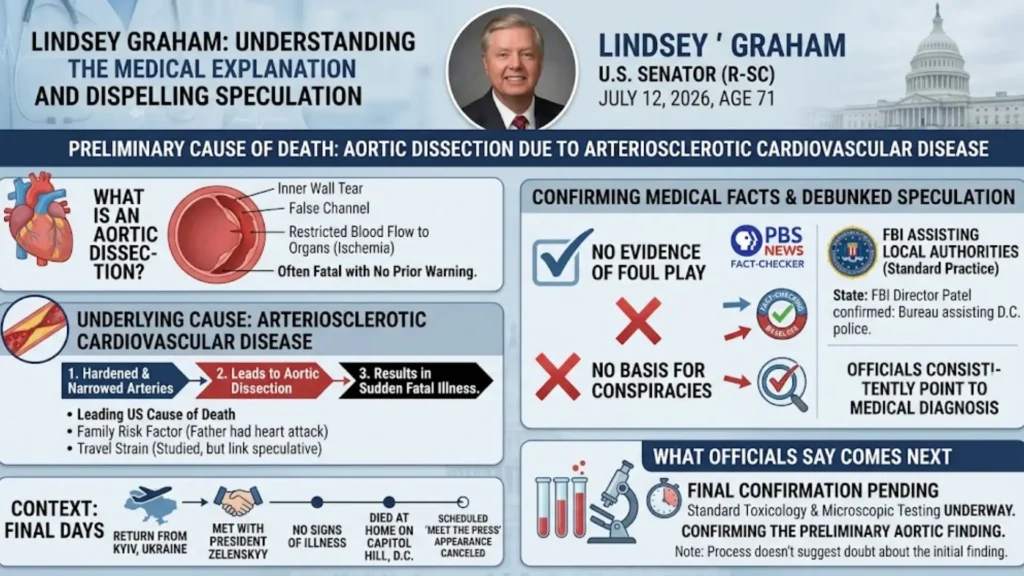
Graham’s office said he passed away from a “brief and sudden illness.” The following day, medical examiners preliminarily attributed his death to an aortic dissection tied to arteriosclerotic cardiovascular disease, a broad term for hardening and narrowing of the arteries. Comprehensive toxicological and microscopic testing was still underway to finalize the official cause of death, which officials said would take additional time.
What Is an Aortic Dissection?
The aorta is the body’s largest artery, carrying blood from the heart to the rest of the body. An aortic dissection happens when a tear develops in the inner wall of the aorta, letting blood tunnel into the layers of the artery wall and create a “false channel.” That false channel can press on the true blood pathway, cutting off adequate blood flow to organs — a condition called ischemia. Doctors note that the tear itself isn’t always what proves fatal; it’s often the resulting loss of blood flow or a full rupture of the artery that turns the condition lethal, and it can happen with little to no warning.
Physicians who study the condition, including specialists at the Medical University of South Carolina, have said sudden deaths are frequently trace back to the aorta. “Anytime somebody dies suddenly, the first thing I think is it’s probably their aorta,” said Dr. Sanford Zeigler, director of thoracic aortic surgery at MUSC’s aortic treatment center, in comments made after Graham’s death.
The Night He Died
Graham died at his home on Capitol Hill on a Saturday night. Emergency responders were call for a report of cardiac arrest, administered CPR at the scene, and transported him to receive further care. He had returned to the U.S. only hours earlier from a trip to Kyiv, Ukraine, where he’d met with Ukrainian President Volodymyr Zelenskyy the day before. A top staffer told reporters there had been no indication beforehand that Graham was feeling unwell. He had been schedule to appear on “Meet the Press” the next morning.
Why It Happened: Underlying Cardiovascular Disease
Arteriosclerotic cardiovascular disease — the underlying condition tied to Graham’s dissection — refers to the gradual hardening and narrowing of arteries, and it’s the leading cause of death in the United States. Family history is a recognized risk factor; Graham’s father died of a heart attack at 68. Cardiologists cautioned after Graham’s death that while long-haul travel, disrupted sleep, and elevated cortisol have been studied in connection with cardiovascular strain, any specific link to his case would be speculative. As one expert put it, the underlying problem may simply have been building for some time regardless of the trip.
Was Anything Else Involved? Addressing the Speculation
Graham’s sudden death, combined with his political profile, triggered a wave of baseless claims online — including suggestions of foul play and questions about FBI activity near his home. FBI Director Kash Patel said the bureau was “assisting local authorities” and had made resources available, standard practice when local police respond to a high-profile death, not an indication of criminal involvement. Fact-checkers, including PBS News, reviewed the claims circulating on social media and found no evidence supporting them; officials have consistently pointed to the aortic dissection finding. Researchers who study misinformation note that sudden deaths of polarizing public figures tend to generate exactly this kind of speculation, in part because a dramatic explanation can feel more emotionally satisfying than a routine, if tragic, medical event.
What Officials Say Comes Next
Officials said toxicological and microscopic testing would take additional time to complete before a final, official cause of death is issue. That process is standard for sudden deaths and is meant to confirm or refine the preliminary finding rather than suggest anything is in doubt about the aortic dissection itself.
Frequently Asked Questions
What was Lindsey Graham’s official cause of death?
The preliminary finding, issued by the D.C. medical examiner’s office, was an aortic dissection due to arteriosclerotic cardiovascular disease. Final results were pending further toxicology and microscopic testing.
What is an aortic dissection?
It’s a tear in the inner wall of the aorta, the body’s main artery, which allows blood to separate the artery’s layers and can cut off blood flow to organs. It can be fatal quickly and often occurs with no prior warning.
Did Lindsey Graham have any known heart problems?
There’s no public indication he had a previously diagnosed heart condition. A staffer said there was no sign he was feeling unwell before his death. His father did die of a heart attack, which is a relevant family risk factor for cardiovascular disease.
Was foul play involve in Lindsey Graham’s death?
No evidence supports that. Claims to that effect spread on social media after his death but were not substantiate; officials have attribute his death to a medical event, and fact-checkers found no basis for foul-play theories.
When did Lindsey Graham die?
He died on the night of Saturday, July 11 into July 12, 2026, at his home in Washington, D.C., shortly after returning from a trip to Ukraine.
How old was Lindsey Graham when he died?
He was 71.
Conclusion
Lindsey Graham’s death was attribute to an aortic dissection brought on by underlying arteriosclerotic cardiovascular disease a serious but medically well-understood condition, not the result of any of the conspiracy claims that circulate afterward. Final confirmation awaited additional toxicology and microscopic testing, standard procedure for a sudden death, but officials have been consistent in pointing to the aortic finding as the cause.