Housing Finance Pakistan 2026: Which Properties Are Eligible for Government Home Loans?
Owning a house is still one of the biggest financial goals for most Pakistani families. But with property prices going up every year, buying a home in cash is simply out of reach for most salaried people. This is where government-backed housing finance steps in.
The most common question people ask is not “how do I get a loan” it is “will my property even qualify?” Banks reject a lot of applications not because of income, but because the house, flat, or plot does not meet the government’s property criteria.
This guide breaks down exactly which properties qualify for government home loans in Pakistan in 2026, what size and price limits apply, and which properties get rejected outright.
Wazir-e-Azam Apna Ghar Program
Many people still search for this facility under its older name, Mera Pakistan Mera Ghar. That name is now largely retired. The active version of the government’s housing finance support is called the Wazir-e-Azam Apna Ghar Program – Ghar Ho Tu Apna, a Profit Rate Subsidy and Risk Sharing Scheme introduced by the Government of Pakistan and regulated by the State Bank of Pakistan (SBP).
The basic idea has not changed:
- The government pays a portion of the markup (interest) for the first several years.
- Commercial and Islamic banks act as the lending partners.
- The scheme applies only to certain types and sizes of property not every house or flat qualifies.
Since names, tiers, and subsidy rates have shifted over the last two years, always confirm the current terms with your bank’s designated housing finance desk before applying. What stays constant, and what this article focuses on, is property eligibility — the part that trips up most applicants.
Also Read: Mera Ghar Mera Ashiana Scheme 2026 Monthly Installment Calculator with Payment Examples
Which Properties Qualify? Size and Price Limits
Government home loan schemes in Pakistan are built around tiers, based on the size of the house or flat. This keeps the subsidy focused on affordable housing rather than luxury property.
Property Tiers at a Glance
| Tier | House Size | Flat/Apartment Size | Typical Use Case |
|---|---|---|---|
| Tier 1 | Up to 125 sq. yards (5 Marla), covered area up to 850 sq. ft | Apartment with covered area up to 850 sq. ft | Small entry-level homes |
| Tier 2 | Up to 125 sq. yards (5 Marla) | Flat with covered area up to 1,250 sq. ft | Slightly larger family homes |
| Tier 3 | Up to 250 sq. yards (10 Marla), covered area up to 2,000–2,720 sq. ft | Flat with covered area up to 1,500–2,000 sq. ft | Maximum size allowed under the scheme |
A few important points about these limits:
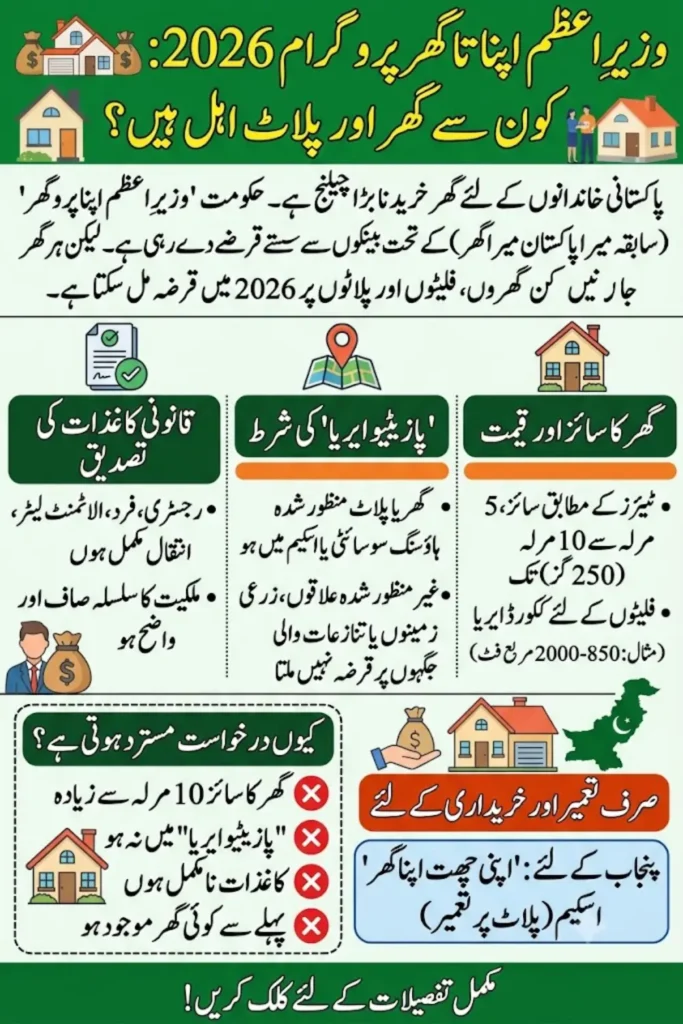
- 10 Marla (2,720 sq. ft.) is the upper ceiling for a house under this facility. Anything bigger does not qualify for the government subsidy, even if you’re eligible in every other way.
- Flats and apartments are measured by covered area in square feet, not by plot size.
- Some banks apply slightly different figures within these tiers, so always check the exact numbers with your bank before signing paperwork.
What This Means in Practice
If you want to buy or build:
- A 5 Marla house in a small housing scheme — likely eligible under Tier 1 or 2.
- A 10 Marla house — the maximum size accepted, falling under Tier 3.
- A 1,500 sq. ft. apartment in an approved building — generally eligible.
- A 1 Kanal (20 Marla) house or bigger — not eligible under this government scheme, regardless of your income level.
Also Read: Mera Ghar Mera Ashiana Loan 2026: Fixed vs Floating Markup – Which Option Saves You More?
Purpose of the Property: What Can You Use the Loan For?
Government home loans are not limited to just buying a ready-made house. The scheme covers three main purposes:
- Purchase – Buying a completed house or flat from the market or a housing society.
- Construction – Building a house on a plot you already own or are purchasing.
- Renovation/Extension – Expanding or improving an existing home you already own (subject to bank policy and remaining size limits).
If you already own a plot within the size limit, construction financing is usually the fastest route, since you skip the property-purchase verification stage and go straight to a construction-linked disbursement plan.
Also Read: Mera Ghar Mera Ashiana Scheme 2026: Islamic vs Conventional Home Financing Which One Is Better?
The “Positive Area” Rule: The Most Overlooked Eligibility Factor
This is where most applicants get caught off guard. Even if your house size and income are perfectly fine, the property must be located in what banks call a “positive area.”
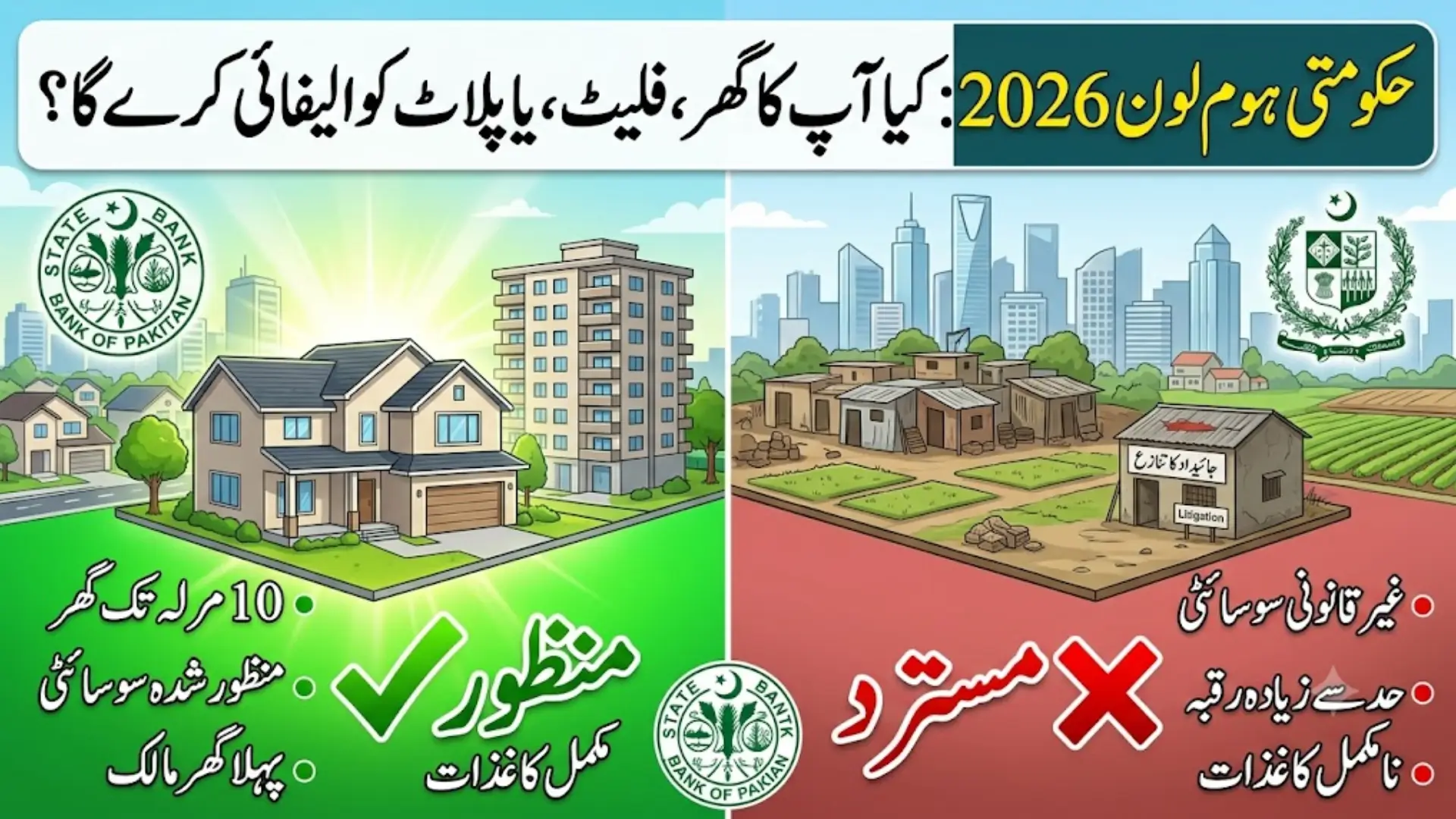
A positive area means the housing society, cooperative scheme, or locality has been formally approved by the bank and the relevant development authority. Properties in unapproved, informal, or disputed housing schemes are automatically excluded — no exceptions.
Examples of the type of localities typically included on positive area lists (this varies by bank and city):
- Government employee cooperative housing societies
- Cantonment board housing schemes
- Development authority-approved housing sectors
- Legally registered private housing societies with clear NOCs
Examples of what usually gets reject:
- Housing societies without a valid No Objection Certificate (NOC) from the relevant development authority
- Illegal or informal katchi abadi-type settlements without regularized title
- Properties under active litigation or ownership disputes
- Land falling in agricultural zones not yet converted for residential use
Before you get emotionally or financially attached to a specific property, ask your bank’s housing finance officer to confirm whether that exact housing scheme or block appears on their approved list. This single check can save you months of wasted paperwork.
Also Read: Can Overseas Pakistanis Apply for Mera Ghar Mera Ashiana Scheme 2026? Complete Guide for NRPs
Property Title and Documentation Requirements
Even a property that fits the size limit and sits in a positive area will not clear the loan unless the title documents are complete and clean. Banks generally require:
- Registry / Sale Deed – proof of the seller’s legal ownership
- Fard-e-Malkiat (record of rights) – confirms current registered owner
- Allotment letter – for properties allotted by a housing authority or society
- Transfer/mutation deed – showing the chain of ownership up to the current seller
- No-demand certificate from the housing society (confirms no dues are pending on the plot/house)
- Approved building plan/map, especially for construction-linked financing
If any of these documents are missing, dispute, or show a different name than the seller’s, the bank will pause or reject the case until the paperwork is correct.
Applicant Eligibility Conditions (Property-Linked Rules)
Some eligibility rules are tied directly to the applicant rather than the property, but they affect which property you can even apply for:
- First-time homeowner rule – You must not already own a house, flat, or residential plot anywhere in Pakistan in your name. This is verified through property record checks.
- One facility per person – An individual can avail this subsidized housing finance facility only once in their lifetime.
- Age limit – Generally between 25 and 60 years for salaried applicants (up to 65 for self-employed individuals) at the time the loan matures.
- CNIC/NICOP requirement – Open to Pakistani citizens and overseas Pakistanis holding a valid CNIC or NICOP.
Government Vs. Private Housing Society Properties
| Property Source | Eligibility Notes |
|---|---|
| NAPHDA-developed housing projects | Directly shortlisted; NAPHDA routes approved applicants to partner banks |
| Cantonment board / government cooperative societies | Generally on positive area lists; smoother verification |
| Reputable private housing societies with NOC | Eligible if size, price, and documentation match scheme limits |
| Unregistered private schemes or informal plots | Not eligible — high rejection risk |
| Agricultural land not converted to residential use | Not eligible until proper land-use conversion is completed |
Provincial Add-On: Apni Chhat Apna Ghar (Punjab)
Alongside the federal scheme, the Punjab government runs its own program for people who already own a small plot but cannot afford construction costs — the Apni Chhat Apna Ghar initiative.
Key property-related eligibility points for this Punjab scheme:
- Applicant must already own 1 to 5 Marla of land in rural areas or 1 to 10 Marla in urban areas.
- The loan is meant strictly for construction on existing land, not for purchasing new property.
- Applicant must qualify under the National Socio-Economic Registry (NSER) with a defined poverty (PMT) score threshold.
This program is a useful option if you already own land in Punjab but sit just outside the income bracket needed for a full commercial bank mortgage.
Common Reasons Properties Get Rejected
Save yourself time by checking these before applying:
- Property size exceeds 10 Marla (house) or the maximum covered area for flats
- Housing society is not on the bank’s approve “positive area” list
- Missing or unclear ownership documents
- Property is under litigation or has a disputed title
- Applicant already owns another residential property anywhere in Pakistan
- Property falls in an illegal or unregularized housing scheme
Step-by-Step: Confirming Property Eligibility Before You Apply
- Shortlist the property (house, flat, or plot) you are interest in.
- Contact your preferred bank’s housing finance desk and ask directly whether that housing society or block is a positive area.
- Confirm the property’s covered area and plot size fall within the tier limits.
- Collect all title documents — registry, fard, allotment letter, and mutation record.
- Verify with NADRA/property records that you do not already own residential property elsewhere.
- Submit your loan application only after these checks are clear, to avoid delays or rejection.
Also Read: Who Can Apply for Mera Ghar Scheme 2026? Complete Eligibility Guide
Frequently Asked Questions
1. What is the maximum house size allow under government home loans in 2026?
The upper limit is generally 10 Marla (250 sq. yards, roughly 2,720 sq. ft.) for a house. Flats are measure separately by covered area, usually up to around 1,500–2,000 sq. ft. depending on the tier and bank.
2. Can I get a loan for a house bigger than 10 Marla?
No. Properties above this size do not qualify for the government’s subsidized housing finance scheme, even if your income supports a bigger loan through regular commercial financing.
3. What does “positive area” mean?
It refers to a housing society, cooperative scheme, or locality that has been formally approve by the bank and relevant development authority. Properties outside these approved areas are not eligible for financing under the scheme.
4. Can I use this loan to renovate my existing house?
Yes, renovation and extension financing is generally available, subject to the property still falling within the scheme’s size limits and the bank’s specific renovation-financing policy.
5. Is a plot without construction eligible for financing?
Financing is typically tied to construction you can get funds to build a house on a plot you own or are purchasing, but simply buying vacant land with no construction plan is usually not cover.
Also Read: Mera Ghar Mera Ashiana Scheme 2026 Monthly Installment Calculator with Payment Examples