
Govt Kicks Off FY2026-27 Budget Process With Climate and Green Budgeting Reforms

FY2026-27 Budget Process
The government of Pakistan has formally started the FY2026-27 budget process with the issuance of the Budget Call Circular by the Finance Division. This step marks the beginning of detailed fiscal planning, setting macroeconomic priorities and timelines for all federal ministries and departments.
FY2026-27 Federal Budget Process
Pakistan launches climate-focused and green budgeting reforms
📜 Budget Call Circular
Formal launch of budget preparation
- Issued by Finance Division
- Sets fiscal priorities
- Defines timelines for ministries
📈 Macroeconomic Outlook
Growth and inflation projections
- GDP growth target 5.1%
- Inflation around 6.5%
- Recovery driven by reforms
🌱 Green Budgeting
Climate reforms in fiscal planning
- Green taxes and subsidies
- Climate tagging introduced
- Sustainability-focused budgeting
💸 Green Revenues
Environmental revenue classification
- Energy and transport levies
- Pollution and resource charges
- International standard alignment
🏷️ Subsidy Tagging
Climate impact assessment of subsidies
- Form III-C introduced
- Impact-based classification
- Transparency in fiscal support
🚨 Disaster Budgeting
Preparedness and recovery planning
- Prevention and preparedness
- Response and reconstruction
- Dedicated cost-center tagging
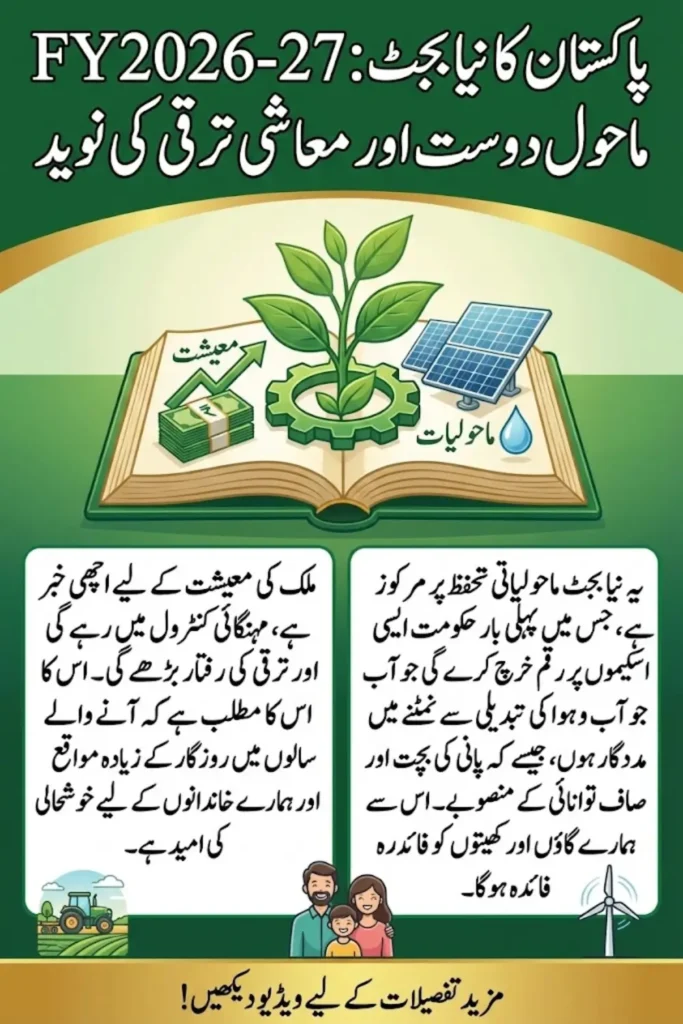
The FY2026-27 budget process is notable for combining economic planning with climate-focused reforms. For the first time, green budgeting, climate tagging of revenues and subsidies, and structured disaster budgeting have been made core components of federal budget preparation.
• Launch of budget preparations through Budget Call Circular
• Focus on macroeconomic stability and climate resilience
• Clear timelines for ministries and departments
Macroeconomic Outlook for FY2026-27
According to the provisional macroeconomic framework, Pakistan’s economy is expect to show steady improvement over the next two fiscal years. GDP growth is project at 4.0 percent in FY2025-26, rising further to 5.1 percent in FY2026-27 as reforms begin to show results.
Inflation is expect to remain under control, easing to around 6.1 percent in FY2025-26 and slightly rising to 6.5 percent in FY2026-27. This outlook is supported by moderating global commodity prices and ongoing structural adjustments.
• GDP growth target of 5.1 percent for FY2026-27
• Inflation expected to stay in mid-single digits
• Economic recovery supported by reforms
Budget Call Circular and Reporting Requirements
The Budget Call Circular outlines detailed instructions for all ministries and Principal Accounting Officers. They are required to submit actual figures for FY2024-25, revised estimates for FY2025-26, and budget estimates for FY2026-27.
A key requirement under the FY2026-27 budget process is the identification and tagging of revenues and expenditures with climate and environmental relevance. This ensures better transparency and alignment with sustainability goals.
• Submission of actuals, revised, and new estimates
• Mandatory climate and environmental tagging
• Standardized reporting across ministries
Also Read: Suzuki Alto VXR 2026 Price in Pakistan New Rate, Features & Booking Update
Introduction of Climate and Green Budgeting
For the first time, the FY2026-27 budget process introduces a structured framework for climate and green budgeting. This includes guidance on green tax revenues, climate-linked subsidies, and disaster-related spending.
The aim is to align fiscal policy with climate resilience and sustainable development. Improved tagging will help policymakers assess how public spending supports or impacts environmental goals.
• Green budgeting introduced at the federal level
• Focus on climate resilience and sustainability
• Improved accountability in public finance
Also Read: BYD Sealion 7 Pakistan 2026: Luxury, Performance, and Advanced Features
Climate Tagging of Federal Revenues
Under the new framework, both tax and non-tax revenues will be assess for their climate relevance. Federal revenues collected by the FBR and non-tax revenues managed by the Finance Division will now include environmental impact assessments.
Levies on environmentally harmful activities such as fossil fuel use, plastics, and hazardous waste are consider positively correlated with climate objectives, as they discourage harmful behavior.
• Climate assessment of tax and non-tax revenues
• Levies on fossil fuels and pollution included
• Environmental impact linked to revenue sources
Also Read: GWM Pakistan Tank 500 Deliveries Revised After Record Demand for HEV and PHEV Models
Green Revenue Classification Categories
To align with global standards, the Finance Division has introduced four base categories for green revenue classification. These categories help standardize reporting and improve comparability.
| Green Revenue Category | Examples Included |
|---|---|
| Energy | Petroleum levies, energy emissions |
| Transport | Vehicle taxes, road usage charges |
| Pollution | Waste, noise, and emission fees |
| Natural Resources | Water and forest extraction levies |
• Four standardized green revenue categories
• Covers energy, transport, pollution, and resources
• Aligns Pakistan with international practices
Also Read: BYD Atto 2 Pakistan Launch: Affordable Electric SUV Redefining Urban Mobility
Climate Tagging of Subsidies
Subsidies form a significant portion of the federal budget, and the FY2026-27 budget process formally extends climate tagging to them. A new Form III-C will be used from FY2025-26 onwards to assess subsidies.
Ministries must classify each subsidy by sector, cost center, and climate purpose. This ensures clarity on whether subsidies support climate adaptation or mitigation.
• Introduction of Form III-C for subsidies
• Mandatory climate classification of fiscal support
• Greater transparency in subsidy spending
Also Read: Deepal S05 Pakistan Launch: First Locally Assembled REEV SUV Now in Deliveries
Classification of Subsidies by Climate Impact
Subsidies will also be evaluate base on their environmental impact. They will be tagged as directly favourable, indirectly favourable, neutral, mixed, or potentially unfavourable.
This classification helps the government assess whether public funds are supporting climate goals or creating environmental risks.
| Impact Category | Description |
|---|---|
| Directly favourable | Strong positive climate impact |
| Indirectly favourable | Supportive but not primary |
| Neutral | No clear climate effect |
| Mixed | Both positive and negative |
| Potentially unfavourable | Environmental risk |
• Impact-based subsidy evaluation
• Helps align spending with climate goals
• Supports informed fiscal decisions
Disaster Budgeting in FY2026-27 Budget Process
Given Pakistan’s vulnerability to climate-induced disasters, disaster budgeting remains a priority. All disaster-related expenditures will continue to be tagged across the federal budget.
Spending will cover both pre-disaster measures such as prevention and preparedness, and post-disaster response including recovery and reconstruction. Each category will carry a specific cost-center code.
• Continued disaster expenditure tagging
• Covers prevention, response, and recovery
• Improved tracking and transparency
Also Read: Suzuki Cultus 2026 Price in Pakistan – Latest Variants, Mileage & Market Update
FY2026-27 Budget Preparation Timeline
The Finance Division has shared a detailed timeline to ensure smooth budget preparation. The provisional macroeconomic framework will be finalized during the current month.
Ministries must submit all key budget forms and estimates by February 20, 2026, while review meetings will take place from late March to mid-April.
• Budget submissions due by February 20, 2026
• Review meetings from March 30 to April 12
• Exchange rate assumptions by April 15
Also Read: Pakistan Moves Closer to 5G Spectrum Auction Approval Signals Digital Breakthrough
Role of APCC and NEC in Budget Approval
The Annual Plan Coordination Committee will meet in the first week of May 2026 to review development priorities. This will be followed by a meeting of the National Economic Council in the second week of May.
These forums play a critical role in aligning national development plans with fiscal resources under the FY2026-27 budget process.
• APCC meeting in early May
• NEC meeting in mid-May
• Alignment of development and fiscal planning
Finalization of FY2026-27 Federal Budget
All federal budget documents are expected to be finalized by the end of May 2026. Ministries are also required to submit quarterly budget estimates by June 30, 2026.
With the issuance of the Budget Call Circular, the government has officially launched a comprehensive and climate-aware FY2026-27 budget process.
• Budget documents finalized by end of May
• Quarterly estimates due by June 30
• Climate reforms integrated into budgeting
FAQs
What is the FY2026-27 budget process?
It is the formal preparation of Pakistan’s federal budget, starting with the Budget Call Circular and ending with budget approval and implementation.
Why is climate budgeting important in FY2026-27?
It helps align public spending with climate resilience, sustainability goals, and better environmental accountability.
What are green revenue categories?
They include Energy, Transport, Pollution, and Natural Resources, used to classify climate-related revenues.
How are subsidies evaluated under the new system?
Subsidies are tagged based on climate adaptation or mitigation and classified by their environmental impact.
When will the FY2026-27 budget be finalized?
All budget documents are expected to be finalized by the end of May 2026.
Also Read:BYD Sealion 7 Pakistan 2026: Luxury, Performance, and Advanced Features


