How Rehmat Card Uses NADRA & PSER to Fight Welfare Fraud
Rehmat Card 2026
Government welfare programmes in Pakistan have a long, frustrating history of manual paperwork, unclear eligibility decisions, and cases where the wrong people end up receiving support meant for someone else. The CM Punjab Rehmat Card was built specifically to close those gaps, using an automated verification system that cross-checks every applicant against multiple government databases before a single rupee gets disbursed.
Why This System Was Necessary
Most welfare schemes in Pakistan have historically relied on manual verification, physical documents, and human judgment calls at each step. This approach leaves real room for error, and unfortunately, for manipulation, whether through duplicate applications, false eligibility claims, or selective favoritism at the local level.
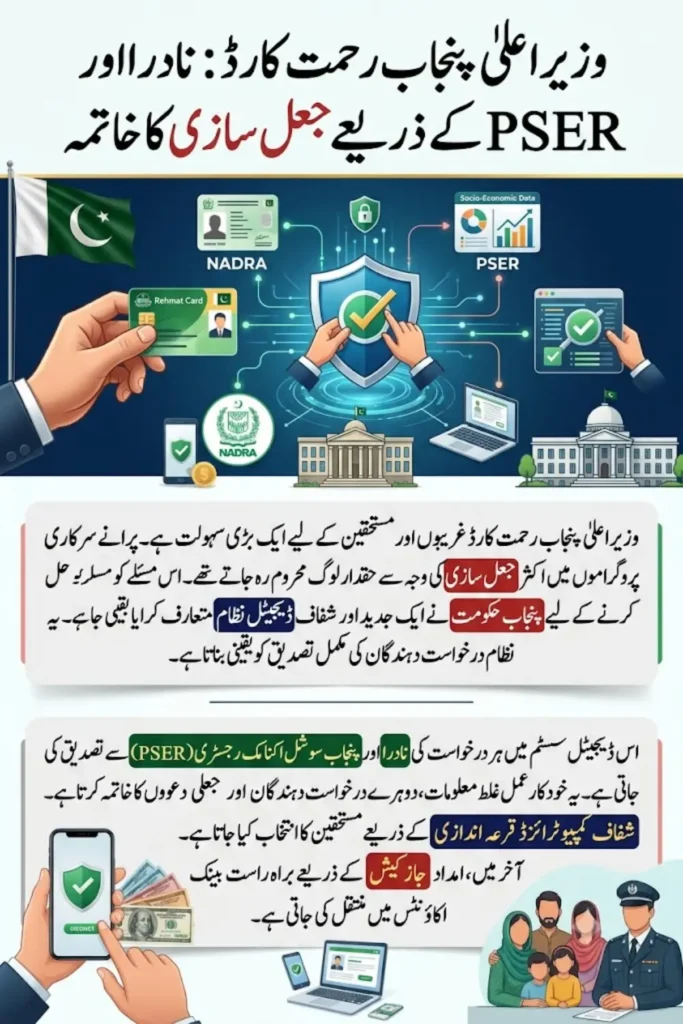
The Rehmat Card was designed differently from the start. Rather than treating digital verification as an add-on feature, it was built as an end-to-end digital ecosystem covering every stage, from a citizen’s initial application to final payment.
Also Read: Rehmat Card Status Check 2026 – Track Your Application Online
Who Built This System
The Rehmat Card initiative is a joint effort involving several government bodies working together on a single technology platform:
- Government of Punjab
- Zakat & Ushr Department
- Punjab Information Technology Board (PITB)
- NADRA
- Punjab Social Protection Authority (PSPA)
- Urban Unit
- JazzCash
PITB served as the technology implementation partner, responsible for designing, developing, and operationalizing the entire digital platform supporting the programme.
Also Read: Rehmat Card Digital Payments Begin – Latest Update 2026
How the Verification Process Actually Works
Understanding this step-by-step makes it clear why this system is harder to manipulate than a manual process.
Step 1: Online Application Submission
Citizens submit their applications through a dedicated online portal or the official Android mobile application, rather than filling out paper forms at a local office.
Step 2: Multi-Agency Database Verification
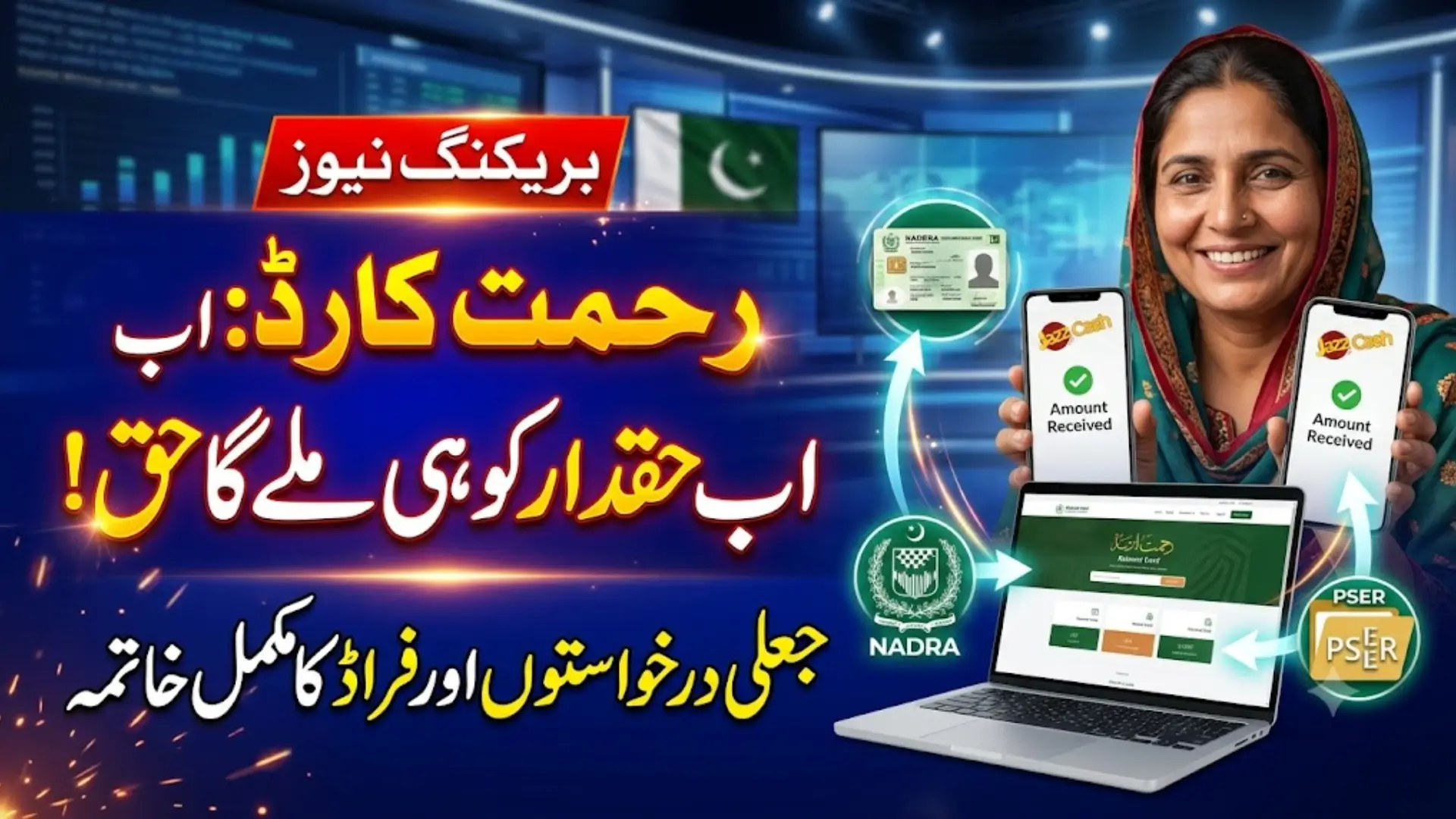
This is the core of the fraud-prevention system. Every application gets checked through a multi-agency digital verification engine that’s directly integrated with two major government databases:
- NADRA, which confirms identity details, CNIC validity, and family records
- Punjab Socio-Economic Registry (PSER), which confirms the applicant’s actual socio-economic status
Because these checks happen automatically against real government records, an applicant can’t simply claim to be a widow or claim a low-income status without it being cross-verified against existing data.
Step 3: Automated Eligibility Scrutiny
Once identity and socio-economic status are confirm, the system runs automated scrutiny workflows to determine whether the applicant actually meets the programme’s eligibility criteria, removing subjective, case-by-case human decision-making from this stage.
Step 4: District Quota Allocation
Eligible applicants are then allocate according to district-wise quotas, ensuring the programme’s benefits are distribute proportionally across Punjab rather than concentrated in specific areas due to uneven application volumes.
Step 5: Computerized Balloting
When eligible applicants exceed available funding within a district, selection happens through a computerize ballot, a transparent, randomize process rather than a manual selection that could be influence by personal connections. The most recent ballot under this system was held on June 23, 2026.
Step 6: Digital Disbursement
Selected beneficiaries receive their payment digitally through JazzCash, closing the loop with a traceable, auditable transaction rather than a cash handout that’s harder to track.
Also Read: Rehmat Card 2026 Eligibility, Registration & Rs. 100,000 Benefit
What Makes This Harder to Manipulate
No Single Point of Manual Override
Because eligibility runs through automated database checks rather than a local official’s personal judgment, there’s significantly less room for someone to bend the rules for a friend, relative, or bribe.
Duplicate Applications Get Caught
Since every application is check against NADRA’s identity records, someone attempting to apply multiple times under slightly different details would be flag by the system rather than slipping through unnotice.
Real-Time Oversight
The platform includes real-time monitoring and decision-support administrative dashboards, giving officials visibility into how the programme is functioning as it happens, rather than discovering problems only after an audit months later.
A Dedicated Complaint Channel
The system includes a dedicated helpline specifically for application support, inquiries, and complaints, giving applicants a formal channel to flag issues rather than having no recourse if something goes wrong.
Also Read: Rehmat Card Status Check 2026 – Track Your Application Online
Officials’ Response to the System’s Completion
At the computerized ballot ceremony marking this phase’s completion, Special Assistant to the Chief Minister (SACM) Rashid Iqbal Nasrullah specifically acknowledged the PITB team for its continuous technical support in delivering the project within tight timelines, along with the guidance provided by PITB Chairman Faisal Yousaf throughout the process.
Secretary of the Zakat & Ushr Department, Irfan Ahmad Sandhu, also commended PITB’s role in designing and operationalizing the digital ecosystem, noting that this is the first initiative of its kind undertaken by the department at this scale and level of technological sophistication.
Also Read: Rehmat Card Digital Payments Begin – Latest Update 2026
Why This Matters Beyond Just Rehmat Card
This system represents a broader shift in how Punjab is approaching welfare delivery. By connecting NADRA and PSER data directly into the eligibility and selection process, the government has created infrastructure that could realistically extend to other welfare programmes in the future, not just Rehmat Card specifically.
For applicants, the practical takeaway is straightforward: your eligibility is determine by what’s actually in your NADRA and PSER records, not by who you know or how convincingly you can argue your case at a local office. Keeping your PSER registration accurate and up to date matters more under this system than it would under a purely manual process.
Also Read: CM Punjab Ration Card 2026: July Payment and Eligibility Update
Conclusion
The Rehmat Card’s fraud-prevention strength comes from removing manual discretion at nearly every step, verifying identity through NADRA, confirming economic status through PSER, allocating fairly by district quota, and selecting transparently through computerized balloting before paying out digitally via JazzCash. For a welfare programme handling public funds meant for widows and orphans, this level of automated cross-checking makes it considerably harder for fraud to slip through compared to older, manual systems.
Also Read: Parwaaz Card 2026: Interest-Free Loan for Punjab Youth Going Abroad
FAQs
How does Rehmat Card verify that an applicant is genuinely eligible?
The system runs applications through a multi-agency digital verification engine integrated with NADRA for identity confirmation and PSER for socio-economic status, before automated workflows determine eligibility.
Can someone submit multiple Rehmat Card applications to increase their chances?
This is much harder under this system, since every application is check against NADRA’s identity records, making duplicate applications more likely to be flag.
What happens if I have a complaint about my Rehmat Card application?
The programme includes a dedicated helpline specifically for application support, inquiries, and complaints.
How are beneficiaries select when there are more eligible applicants than funding?
Through a transparent computerized ballot, conducted on a district-wise basis, with the most recent ballot held on June 23, 2026.
Who built the Rehmat Card’s digital verification system?
The Punjab Information Technology Board (PITB) served as the technology implementation partner, working alongside NADRA, PSPA, the Zakat & Ushr Department, and JazzCash.
Does my PSER registration status affect my Rehmat Card eligibility?
Yes, since the system checks your socio-economic status directly against your PSER records, keeping this registration accurate matters for accurate eligibility determination.
Also Read: CM Punjab Ration Card 2026: Eligibility, Documents, and How to Apply