Petrol Up Rs. 1.63, Diesel Up Rs. 1.55 – July 29 Rates

Petrol Up Rs. 1.63, Diesel Up Rs. 1.55
Just a day after motorists got a small break, fuel prices in Pakistan climbed again. Petrol and diesel both went up for July 29, 2026, and this time the reason traces back to real tension thousands of kilometers away, in one of the world’s most critical oil shipping routes.
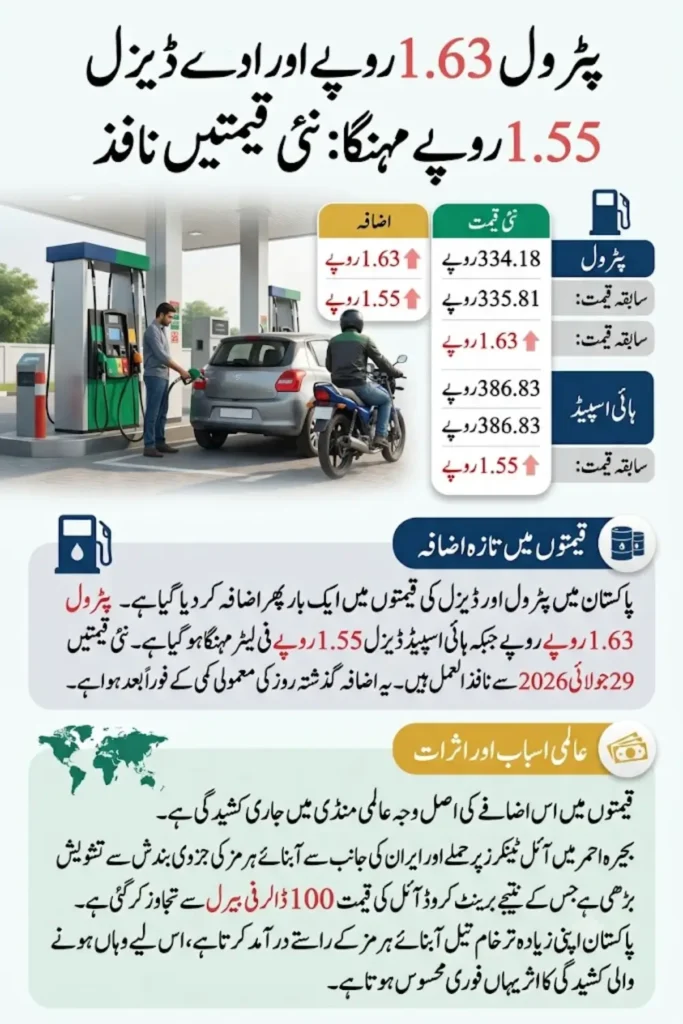
Today’s Prices
The Oil and Gas Regulatory Authority (OGRA) issued a fresh notification revising fuel rates for the next 24 hours, effective from midnight.
| Fuel | Previous Price | New Price | Change |
|---|---|---|---|
| Petrol | Rs. 334.18/liter | Rs. 335.81/liter | Up Rs. 1.63 |
| High-Speed Diesel | Rs. 386.83/liter | Rs. 388.38/liter | Up Rs. 1.55 |
This comes just one day after petrol had actually dropped by Re1, while diesel had jumped by a sharper Rs. 3.37. In other words, the small relief motorists got yesterday didn’t last even 24 hours.
Why Prices Jumped Again So Quickly
The real story behind today’s increase isn’t domestic policy. It’s a serious escalation in global oil markets triggered by events in the Middle East.
Attacks on Tankers in the Red Sea
Reports of attacks on oil tankers passing through the Red Sea have raised fresh concerns about the safety of one of the world’s busiest oil shipping corridors. When tankers can’t move safely through a route this critical, global supply expectations tighten immediately, and prices react fast.
Iran’s Near-Closure of the Strait of Hormuz
At the same time, Iran has moved to nearly close the Strait of Hormuz, another vital passage that a huge share of the world’s oil supply depends on. Together, these two developments choked off what analysts describe as two crucial Middle East arteries for global oil supply within the same week.
The Result: Brent Crude Crossed $100 a Barrel
Brent crude jumped 6% to $100.50 a barrel, the first time it crossed the $100 mark since May. This is a significant psychological and financial threshold in oil markets, and it rattled more than just fuel prices. Major tech stocks in the US fell on the news, and borrowing costs in Europe spiked to long-term highs on the same unsettling trading day.
Why This Matters More to Pakistan Than Most Countries
Pakistan imports the vast majority of its oil, largely through the Strait of Hormuz from Saudi Arabia and the UAE. When that specific route comes under pressure, Pakistan doesn’t just feel a general global price increase, it feels direct exposure to a supply route it heavily depends on.
This is exactly why Pakistan’s fuel prices are responding so quickly and visibly right now, compared to countries with more diversified oil import routes.
Also Read: CM Punjab Solar Scheme 2026: Eligibility & Status Check
How Pakistan’s Daily Pricing System Is Showing This in Real Time
Earlier this year, Pakistan shifted from revising fuel prices every two weeks to adjusting them every single day. Under this system, OGRA calculates prices using a seven-working-day average of international oil rates, combined with the exchange rate, and publishes updated rates daily.
This is precisely why you’re seeing prices swing both up and down within just 48 hours, a Re1 cut on July 28, followed by a Rs. 1.63 increase on July 29. Under the old fortnightly system, this kind of rapid market movement might not have shown up at the pump for another week or more.
What Officials Have Said About the New Pricing Framework
Alongside the daily pricing shift, the government has laid out additional rules meant to bring more structure to fuel pricing:
- The petroleum levy cannot be charged above the limit set by the federal cabinet, and any change requires Finance Ministry approval
- OGRA has been required to publish international reference prices on its website daily since July 1, 2026, specifically for transparency
- Oil Marketing Companies (OMCs) can be declared ineligible to import fuel for up to nine months if they violate import terms
- Kerosene oil and light diesel oil rates are also now fixed daily, alongside petrol and diesel
These measures suggest the government is trying to balance faster, more responsive pricing with added oversight, given how much volatility the daily system can introduce.
Also Read: Mera Ghar Mera Ashiana – Common Mistakes That Get You Rejected
What to Expect If Tensions Continue
If the situation around the Red Sea and the Strait of Hormuz doesn’t ease, further price increases in the coming days are a realistic possibility. Oil markets tend to stay jumpy during active shipping route disruptions, and Pakistan’s daily pricing mechanism means that volatility will likely keep showing up at the pump quickly rather than being smoothed out over a longer cycle.
On the other hand, any sign of de-escalation, whether through diplomatic movement or improved tanker security, could bring prices back down just as quickly, the same way petrol briefly dropped on July 28 before rising again today.
Also Read: Why Petrol Fell But Diesel Rose – Pakistan Fuel Prices Explained
Conclusion
Petrol and diesel both rose again for July 29, 2026, driven not by local tax changes but by a serious supply scare in the Middle East, tanker attacks in the Red Sea and Iran’s near-closure of the Strait of Hormuz pushed Brent crude past $100 a barrel for the first time since May. Since Pakistan relies heavily on this exact shipping route for its oil imports, expect prices to keep moving quickly under the new daily pricing system until the situation stabilizes.
Also Read: One Edition Lahore – British-Pakistani Group’s $35M Housing Project
FAQs
What is today’s petrol and diesel price in Pakistan?
As of July 29, 2026, petrol costs Rs. 335.81 per liter and high-speed diesel costs Rs. 388.38 per liter.
Why did fuel prices increase again so soon after a price cut?
Global oil prices spiked sharply due to tanker attacks in the Red Sea and Iran’s near-closure of the Strait of Hormuz, pushing Brent crude above $100 a barrel and prompting an immediate price revision under Pakistan’s daily pricing mechanism.
Why does the Strait of Hormuz matter so much to Pakistan’s fuel prices?
Pakistan imports most of its oil from Saudi Arabia and the UAE through this route, so any disruption there directly affects the country’s fuel supply costs.
How often does Pakistan revise petrol prices now?
Fuel prices are revised daily, based on a seven-working-day average of international oil rates combined with the exchange rate.
Can the government raise the petroleum levy whenever it wants?
No. The levy cannot exceed the limit set by the federal cabinet, and any change requires approval from the Finance Ministry.
What happens to Oil Marketing Companies if they violate import rules?
They can be declared ineligible to import fuel for up to nine months under the government’s revised petroleum import framework.
Also Read: FBISE Result 2026 – New Grading System Explained (A++ to U)